
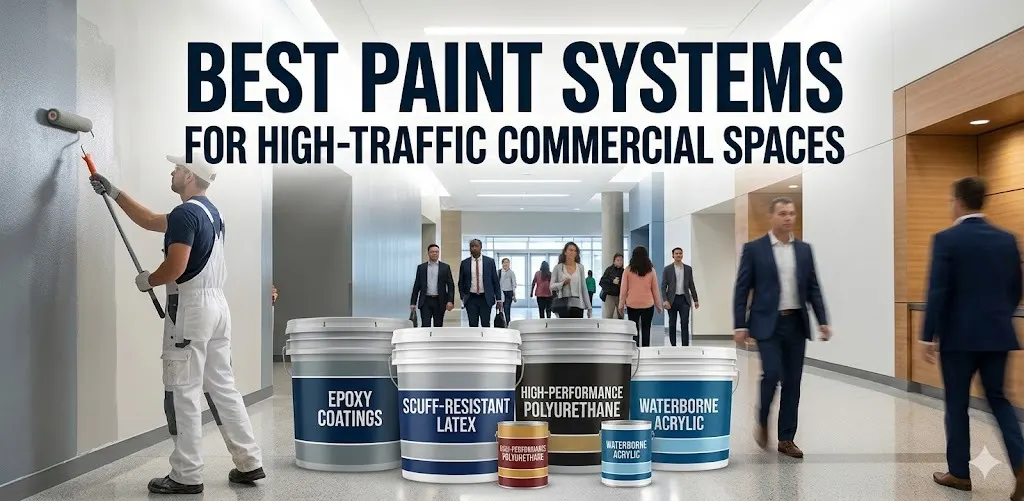
Best paint systems for high-traffic commercial spaces are specialised coating formulations combining acrylic latex durability, epoxy chemical resilience, and high-solids content (45-55%) delivering 7–10-year service life while resisting scuffs, stains, and mechanical impact in areas experiencing 500+ daily interactions.
Selecting the best paint systems for high-traffic commercial spaces addresses 5 critical performance requirements: mechanical abrasion resistance, chemical stability, washability durability, aesthetic longevity, and substrate compatibility.
These coating systems utilise 2 critical components: acrylic latex for flexibility and durability, and epoxy for chemical resilience in extreme-duty environments. This structural precision eliminates aesthetic degradation and reduces the frequency of commercial repainting cycles by 400%.
Understanding High-Traffic Commercial Environment Demands on Paint Systems
To understand high-traffic commercial environment demands on paint systems, identify areas experiencing 500+ daily interactions, such as corridors, lobbies, and healthcare facilities. These environments require formulations containing 45–55% solids by volume to provide the film thickness necessary for resisting mechanical abrasion and environmental stress.
High-traffic commercial spaces are areas experiencing 500+ daily interactions, including corridors, lobbies, retail environments, hospitality venues, and healthcare facilities.
These environments destroy standard residential paints rapidly through constant contact, cleaning, and environmental exposure.
Commercial-grade paint systems differ fundamentally from residential products.
Standard residential paints contain 35-40% solids by volume. Commercial-grade formulations contain 45-55% solids, providing superior film thickness and abrasion resistance.
The higher solids content creates denser coating films withstanding mechanical stress without premature wear or aesthetic degradation.
Paint failure in commercial spaces costs businesses through:
- Emergency repainting is disrupting operations
- Poor brand image from shabby appearances
- Health code violations in regulated industries
- Increased maintenance labour expenses
- Customer complaints and negative reviews
Proper paint system selection eliminates these problems.
Acrylic Latex Paint Systems: The Commercial Workhorse Solution
Acrylic latex paint systems for commercial use are water-based formulations combining acrylic polymers with latex binders to support 80% of business applications. These systems achieve drying times of 2–4 hours and washability ratings exceeding 3,000 scrub cycles, making them ideal for retail stores and hospitality venues.
These systems dominate offices, retail stores, and hospitality environments, requiring reliable performance without extreme chemical or impact resistance.
High-performance acrylic latex advantages include:
- Drying times of 2-4 hours between coats, minimising downtime
- VOC content under 50g/L meeting health regulations
- Washability ratings exceeding 3,000 scrub cycles
- Colour retention lasting 5-7 years under fluorescent lighting
- Application versatility across plasterboard, concrete, and previously painted surfaces
Scrub cycle rating measures how many cleanings cycles paint withstands before showing wear or colour loss.
Premium acrylic latex systems from Sherwin-Williams and Benjamin Moore achieve 5,000+ scrub cycles compared to 1,500 cycles for residential-grade products.
This performance difference extends repainting intervals from 2-3 years to 7-10 years substantially.
When specifying acrylic latex for commercial projects, surface preparation quality determines 60% of final performance regardless of paint quality.
Professional painters like Luxury Design Painting understand substrate conditioning requirements, ensuring proper adhesion and maximum coating lifespan.
Epoxy Coatings for Extreme-Duty Commercial Applications
Epoxy coatings for extreme-duty commercial applications utilise two-component resin chemistry to create impact-proof surfaces in industrial zones. Epoxy systems provide zero permeability and a 4H–6H pencil hardness rating, essential for 4 specific areas: loading docks, commercial kitchens, chemical storage, and hospital hallways.
| Coating Type | Primary Application Areas |
| Epoxy floor coatings | Industrial floors, loading docks, workshops |
| Epoxy wall systems | Chemical storage areas, commercial kitchens |
| High-performance acrylic systems | High-abrasion corridors, stairwells |
| Premium acrylic latex coatings | Moderate-duty retail and office spaces |
Performance characteristics distinguishing epoxy coating systems include:
- Impact resistance to withstand forklift and trolley contact
- Chemical resistance to cleaning agents, oils, and solvents
- Film hardness ratings of 4H-6H on the pencil hardness scale
- Service life of 10-15 years in industrial environments
- Zero permeability prevents moisture penetration
Film hardness rating measures coating resistance to scratching using standardised pencil leads from 6B (soft) to 9H (hard).
Application requirements for epoxy coating systems demand professional expertise. Surface preparation includes diamond grinding or acid etching. Application timing windows of 4-8 hours exist between mixing and usability. Environmental controls maintain 15-25°C temperatures during curing.
DIY attempts fail catastrophically, creating adhesion problems and premature coating failure.
Specialised Commercial Coating Solutions Beyond Standard Paint Systems
Specialised commercial coating solutions are beyond standard paint systems. Specialised commercial coating solutions target unique environmental challenges like vandalism, moisture, and physical scuffing.
- Install anti-graffiti coatings to allow for spray paint removal without surface damage.
- Apply scuff-resistant paints in hospitality corridors to hide marks from trolleys and equipment.
- Utilise antimicrobial coatings in humid commercial kitchens to prevent biological growth.
These systems protect exterior public-facing walls in retail, education, and transportation facilities experiencing vandalism.
Two anti-graffiti technologies exist:
- Sacrificial coatings wash away with graffiti during cleaning
- Permanent coatings allow graffiti removal without coating damage
Scuff-resistant paints contain specialised ceramic or mineral additives creating matte or satin finishes, hiding black scuff marks from shoes, trolleys, and equipment. Standard paints show every scuff mark within weeks. Scuff-resistant formulations hide marks while maintaining cleanable surfaces.
Hospitality corridors, retail fitting rooms, and healthcare hallways benefit dramatically from scuff-resistant technology. Mould and mildew-resistant paints incorporate fungicides and antimicrobial agents, preventing biological growth on painted surfaces in humid environments.
Bathrooms, commercial kitchens, laundries, and basement areas require these formulations to meet health code requirements. Mould growth on standard paints creates health hazards, aesthetic problems, and regulatory violations simultaneously.
Optimal Finish Selection for Durability and Aesthetic Balance
Optimal finish selection is necessary for maintaining durability and aesthetic balance. The optimal paint finish describes the level of light reflection from dried coating surfaces, measured from flat (0% gloss) to high-gloss (85%+ gloss).
Finish selection balances durability requirements against aesthetic preferences.
Semi-gloss finishes reflect 35-70% of light, creating shiny surfaces with maximum washability and stain resistance.
High-contact areas, including trim, doors, handrails, and corridor walls, benefit from semi-gloss durability.
These finishes survive 5,000+ scrub cycles, maintaining appearance under aggressive cleaning protocols.
Satin or low-sheen finishes reflect 10-35% of light, providing subtle elegance with good durability for moderate-traffic areas.
Lobbies, reception areas, and hallways achieve professional aesthetics while maintaining cleanability adequate for commercial use.
Eggshell finishes reflect 5-10% of light, offering soft appearances suitable for waiting rooms, consultation spaces, and areas requiring warmth over durability.
The finish hierarchy for commercial applications prioritises function:
- Ultra-high traffic: Semi-gloss mandatory
- High traffic: Satin minimum requirement
- Moderate traffic: Satin or eggshell acceptable
- Low traffic: Eggshell or flat permissible
Mixing finishes within single spaces creates maintenance nightmares and inconsistent cleaning results.
Premium Brand Recommendations Delivering Proven Commercial Performance
The following are the 6 premium brands that provide paint systems for high-traffic commercial spaces.
Sherwin-Williams offers ProMar and Emerald lines specifically engineered for commercial durability with superior colour retention and washability ratings.
Sherwin-Williams products dominate large commercial installations through consistent quality, wide colour selection, and technical support.
Benjamin Moore provides Regal Select and Aura commercial-grade formulations, excelling in high-traffic interior applications with exceptional hide and coverage.
Benjamin Moore systems achieve superior one-coat coverage, reducing labour costs on large commercial projects.
PPG Paints and Glidden Professional manufacture high-performance coatings designed for industrial facilities requiring maximum abrasion resistance and chemical stability.
These brands suit warehouses, manufacturing facilities, and heavy industrial applications.
Dunn-Edwards specialises in large-scale commercial applications with products formulated for high-volume projects and aggressive cleaning protocols.
Regional availability varies, but quality remains consistent across product lines.
When comparing commercial paint systems, evaluate the total cost of ownership rather than the initial purchase price.
Premium systems costing 30% more upfront deliver 200% longer service life, reducing total ownership costs by 40-50% over 10-year periods.
Understanding the best paint systems for high-traffic commercial spaces enables informed decisions, protecting investments while maintaining professional appearances that support brand image and operational efficiency.
Conclusion
To protect commercial property investments, select high-performance paint systems from premium brands like Sherwin-Williams, Benjamin Moore, and PPG. Choosing systems with 45%+ solids content and semi-gloss finishes reduces total ownership costs by 40–50% over a 10-year operational cycle.
Semi-gloss finishes provide maximum durability for high-contact surfaces. Premium brands, including Sherwin-Williams, Benjamin Moore, and PPG, deliver proven performance justifying higher initial investment through extended service life and reduced total ownership costs.
Don’t compromise your commercial property with inadequate paint systems that fail prematurely under traffic stress. Contact Luxury Design Painting for expert specification guidance, professional application, and commercial-grade coating solutions engineered for Australian business environments, delivering durability, aesthetics, and long-term value simultaneously.
Praptie
Luxury Design Painting