
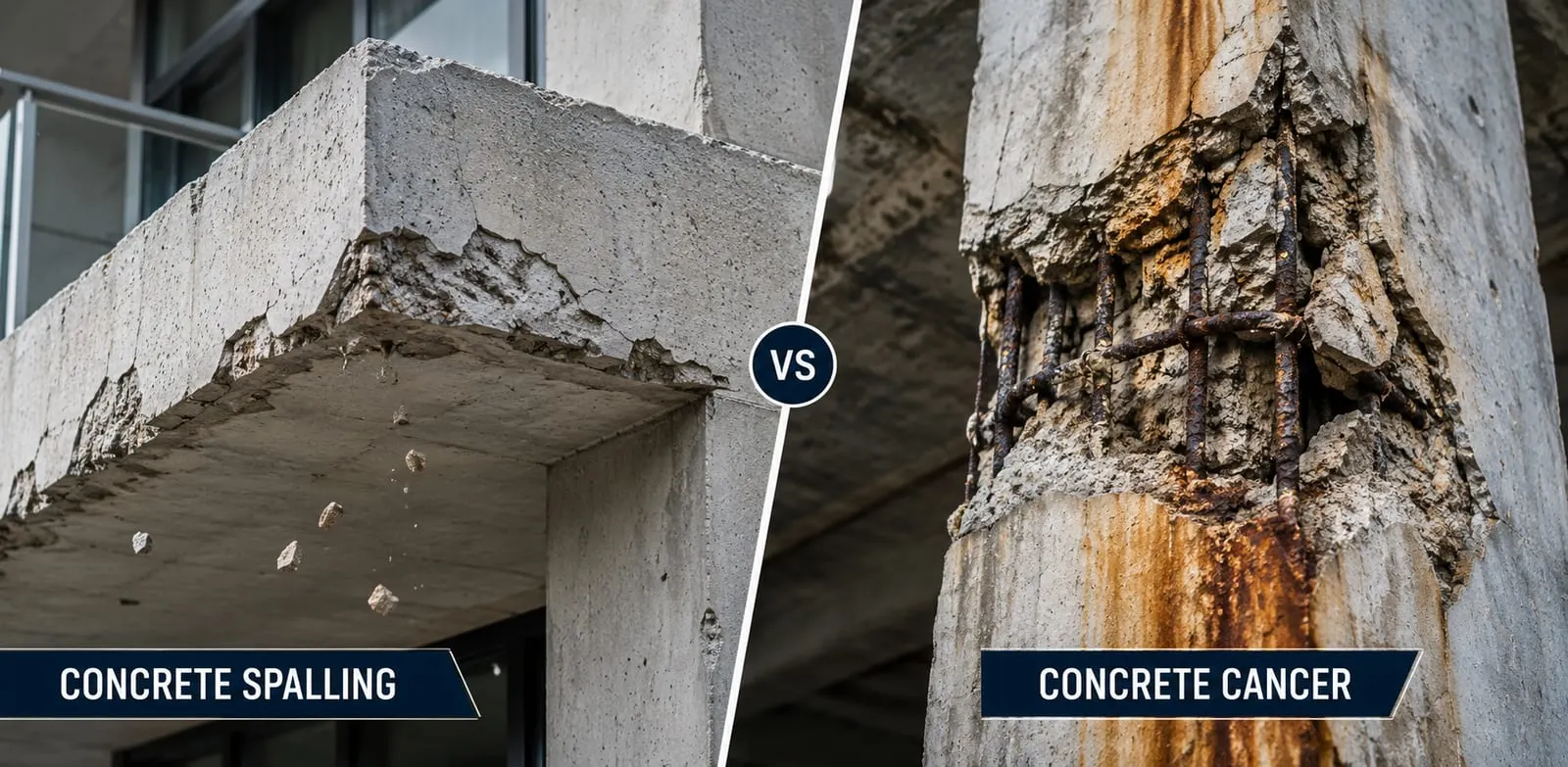
Concrete spalling is the breaking, flaking, or detachment of concrete from a surface. Concrete cancer describes deterioration in reinforced concrete where corrosion of the steel reinforcement causes the surrounding concrete to crack, expand, and break away.
The terms are closely connected, but they do not mean the same thing.
Spalling describes what is happening to the concrete surface. Concrete cancer describes a deterioration process commonly associated with corrosion of reinforcement inside the concrete.
For Sydney buildings, early diagnosis matters. Moisture, chloride exposure, failed waterproofing, cracking, and ageing protective coatings can allow deterioration to continue behind a surface that initially looks like a minor repair.
Concrete Spalling vs Concrete Cancer
Here is the simplest way to separate the two terms:
| Concrete Spalling | Concrete Cancer |
|---|---|
| Concrete flakes, chips, or breaks away | Reinforcing steel corrodes inside the concrete |
| Describes visible concrete deterioration | Describes an underlying deterioration process |
| Has several possible causes | Closely linked with reinforcement corrosion |
| Does not always mean steel has corroded | Can cause cracking and spalling as corrosion progresses |
| Repair depends on the cause | Requires treatment of the corrosion and damaged concrete |
This distinction matters because patching broken concrete without identifying why it failed does not provide a complete repair.
What Is Concrete Spalling?
Concrete spalling occurs when part of the concrete surface cracks, flakes, chips, or separates from the material underneath.
The damage ranges from shallow surface deterioration to larger sections breaking away and exposing aggregate or reinforcing steel.
You can see spalling on balconies, concrete slabs, building facades, columns, beams, walls, and other concrete elements.
The visible damage is a symptom.
Before repairing it, the underlying concrete needs to be inspected to determine what caused the material to separate.
What Is Concrete Cancer?
Concrete cancer is a common Australian term for deterioration involving corrosion of the reinforcing steel embedded inside concrete.
Reinforced concrete contains steel bars that provide tensile strength.
Sound concrete creates an alkaline environment that helps protect this reinforcement. When that protection is lost, and sufficient moisture and oxygen reach the steel, corrosion starts.
Chloride contamination provides another pathway to reinforcement corrosion and is particularly important for structures exposed to salt.
As steel corrodes, the corrosion products occupy greater volume than the original steel. This expansion creates pressure against the surrounding concrete.
The sequence can progress like this:
Moisture or chlorides reach reinforcement > Steel corrodes > Corrosion products expand > Internal pressure increases > Concrete cracks > Concrete separates and spalls
This is why visible spalling can be one of the later signs of deterioration rather than the beginning of the problem.
What Causes Concrete Spalling?
Spalling has more than one cause, so visible broken concrete should not automatically be labelled concrete cancer.
Corroding Reinforcement
Reinforcement corrosion is a major cause of spalling in reinforced concrete.
Once corrosion expands around the steel, pressure builds against the concrete cover. Cracks develop along the reinforcement before sections begin breaking away.
Rust staining alongside cracking or exposed steel provides an important warning sign.
Carbonation of Concrete
Carbonation occurs when carbon dioxide from the air reacts with components within concrete and lowers its alkalinity.
If carbonation reaches the reinforcement, the protective environment around the steel is reduced. In the presence of moisture and oxygen, corrosion can begin.
The concrete can still look solid at the surface while this process develops deeper inside it.
Chloride and Coastal Exposure
Salt exposure is particularly relevant to Sydney's coastal environment.
Chlorides can penetrate concrete and disrupt the protective condition around reinforcing steel. Structures close to the coast face greater chloride exposure through salt-laden air and sea spray.
Balconies, exposed facades and other elements facing coastal weather deserve particular attention.
Simply painting over rust stains or cracks does not remove chloride contamination already present within the concrete.
Water Entry and Failed Waterproofing
Water entering through cracks, failed joints, balconies, roofs, or defective waterproofing keeps concrete exposed to moisture.
Moisture becomes particularly serious once it reaches reinforcement where the conditions for corrosion already exist.
Finding where the water comes from therefore forms part of the repair. Otherwise, the repaired concrete remains exposed to the same problem.
Poor Concrete Cover
Steel reinforcement needs sufficient concrete cover.
When reinforcement sits too close to the surface, there is less concrete protecting it from carbonation, chlorides and moisture.
Once corrosion develops, spalling can appear directly over the reinforcement.
Physical Damage and Other Deterioration
Not all spalling comes from reinforcement corrosion. Impact damage, poor original construction, incompatible previous repairs, and other forms of concrete deterioration can also cause material to break away. This is another reason diagnosis comes before repair.
What Are the Warning Signs of Concrete Cancer?
Concrete cancer does not start when a large piece of concrete falls off.
Earlier warning signs can appear first.
Look for:
- Rust-coloured staining
- Cracks following reinforcement lines
- Bulging concrete
- Flaking or broken surfaces
- Exposed reinforcing steel
- Hollow or drummy areas
- Recurring cracks after previous repairs
- Water staining or leaks near damaged concrete
Cracking alone does not confirm reinforcement corrosion.
The location, pattern, moisture conditions, and condition of the surrounding concrete all need to be considered.
A professional inspection becomes more important when several warning signs appear together.
What Does Hollow or Drummy Concrete Mean?
Concrete that produces a hollow or drummy sound when appropriately tested can indicate that a section has separated from the sound concrete underneath.
This is known as delamination.
The surface can still appear intact even though its bond has already failed below.
That creates a practical safety concern on elevated facades, balconies and other areas where detached material could eventually fall.
Painting a drummy section does not reconnect it.
The extent of unsound concrete needs to be identified before the repair method is selected.
How Is Concrete Spalling and Concrete Cancer Assessed?
A proper assessment looks beyond the visible broken edge.
The first stage is to inspect the location, cracking, rust staining, water entry, previous repairs, and condition of the surrounding concrete.
The investigation can then determine whether deterioration is localised or extends beyond the visibly damaged area.
Depending on the building and severity of the problem, specialist investigation can include testing related to carbonation, chlorides, concrete condition and reinforcement.
Structural concerns require assessment by an appropriately qualified engineer.
Luxury Design Painting's experience with building remedial work in Sydney includes working with deteriorated building surfaces where the cause needs to be addressed before the final coating system is restored.
How Is Concrete Cancer Repaired?
Concrete cancer repair needs to address both the damaged concrete and the corrosion process responsible for it.
The exact repair specification depends on the cause, depth, and extent of deterioration.
Remove Unsound Concrete
Loose, cracked, and delaminated concrete needs to be removed back to a suitable sound substrate as required by the repair specification.
Simply filling over loose material creates a repair attached to a failing base.
Removal also exposes affected reinforcement so its condition can be assessed.
Treat the Reinforcement
Corroded reinforcement requires appropriate preparation and treatment.
Rust and corrosion products need to be dealt with according to the repair system. Where reinforcement has suffered significant section loss or the damage raises structural concerns, engineering input is required.
Covering rusty steel with new repair material without appropriate preparation leaves the underlying problem unresolved.
Repair the Concrete
Once the area is properly prepared, compatible repair materials can rebuild the removed section.
The repair needs to work with the existing concrete and restore the required profile around the reinforcement.
Large, deep, or structurally significant repairs need a repair specification suited to the building rather than a generic patching approach.
Stop the Source of Moisture
Repairing concrete while allowing water to continue entering the area leaves a major deterioration factor in place.
Failed waterproofing, joints, sealants, cracks, or drainage defects need attention where they contribute to the problem.
This stage separates a proper remedial repair from a cosmetic patch.
Apply the Required Protective Finish
Once repairs are completed and the substrate is ready, the surface can receive its specified protective coating or finishing system.
The coating helps protect the repaired facade from exterior exposure and creates a consistent appearance across repaired and existing sections.
Luxury Design Painting provides concrete cancer repair in Sydney as part of its remedial building services.
Can You Just Patch Concrete Spalling?
A local patch is suitable only when the cause and full extent of the deterioration have been identified.
Cutting out the visibly loose section and filling the hole without investigating the surrounding concrete can leave corrosion active beside the repair.
The new patch then looks finished while deterioration continues around its edges.
Recurring repairs in the same location are a strong reason to investigate what sits behind the visible damage.
A lasting repair starts with cause > extent > preparation > repair > protection.
Not filler first.
Is Concrete Cancer Dangerous?
Concrete cancer becomes a safety concern when deterioration affects the integrity of the concrete or creates loose material that can detach.
The level of risk depends on where the damage is located and how far it has progressed.
Loose concrete on an elevated balcony, facade or overhead element requires prompt attention because falling material creates an immediate hazard.
Structural concerns require professional engineering assessment. Do not rely on paint, filler or visual appearance to judge the safety of deteriorated reinforced concrete.
Does Concrete Cancer Spread?
Corrosion-related deterioration continues while the conditions supporting corrosion remain.
That does not mean concrete cancer spreads like a biological disease.
Instead, moisture, chlorides, carbonation and reinforcement conditions can affect areas beyond the first visible patch.
This explains why repairing only the obvious spalled section can fail to solve the broader problem.
The surrounding concrete needs inspection as part of the repair.
How Can Concrete Spalling Be Prevented?
Prevention focuses on keeping the concrete and its protective systems in good condition.
Repair cracks before they provide easier paths for moisture. Maintain waterproofing, sealants, and drainage. Keep exterior protective coatings in serviceable condition.
Coastal buildings also need close attention to salt exposure and deterioration around balconies and exposed facades.
Regular inspections help identify rust staining, cracking, failed coatings, and water entry before larger sections of concrete become loose.
Early action reduces the amount of material that eventually needs remedial work.
Frequently Asked Questions
Is concrete spalling the same as concrete cancer?
No. Spalling describes concrete breaking or separating from the surface. Concrete cancer describes deterioration associated with reinforcement corrosion, which can cause spalling.
What does concrete cancer look like?
Common signs include rust staining, cracking, bulging concrete, spalling, exposed reinforcement, and hollow or drummy areas.
Can you paint over concrete cancer?
No. Painting does not treat corroding reinforcement or repair delaminated concrete. The underlying deterioration needs to be addressed first.
Does all spalling mean the reinforcement is rusting?
No. Concrete can spall for several reasons. The cause needs to be identified before choosing the repair.
Who should assess serious concrete cracking?
An appropriately qualified engineer should assess cracking or deterioration where structural integrity is in question.
Can concrete cancer be repaired?
Yes. Repair involves identifying the cause, removing unsound material, appropriately treating affected reinforcement, rebuilding the concrete, and addressing moisture or other contributing conditions.
Fix the Cause, Not Just the Broken Concrete
Concrete spalling is the visible damage. The more important question is why the concrete failed.
If reinforcement corrosion, moisture, or another underlying defect caused the damage, covering the surface will not stop deterioration.
Luxury Design Painting brings more than 30 years of experience across painting and remedial building work in Sydney. Our team assesses deteriorated surfaces, completes appropriate remedial repairs within our scope, and restores the protective finishing system once the substrate is ready.
If your building has cracking, rust staining, hollow concrete, or sections beginning to break away, contact Luxury Design Painting to arrange an assessment before the deterioration becomes a larger repair project.
admin
Luxury Design Painting