
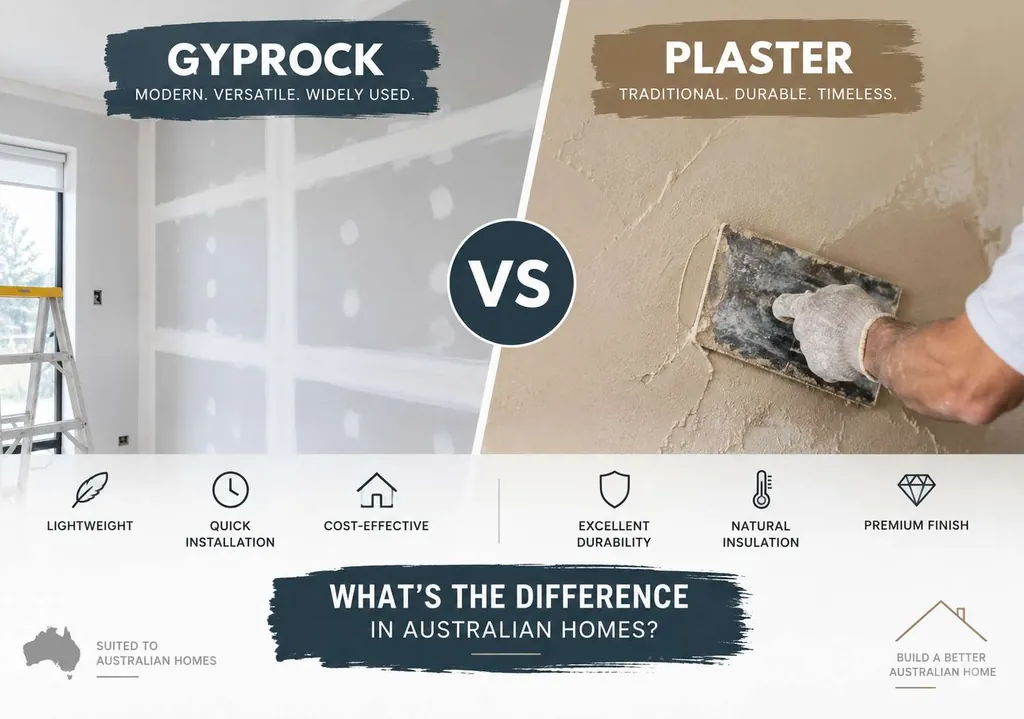
Gyprock and plaster are different wall and ceiling systems, even though the terms are sometimes used interchangeably in Australia. Gyprock is a well-known Australian brand of plasterboard, which consists of pre-made gypsum-core sheets fixed to framing. Traditional plaster is mixed and applied wet over a suitable surface, then worked and finished by hand.
Both systems can create smooth, premium walls and ceilings. The right choice depends on what already exists, whether you are building or repairing, the age of the property and the final finish you want.
For Sydney homeowners, the useful question is not simply, “Which is better?” It is, “Which system suits this particular wall, ceiling or renovation?”
What Is Gyprock?
Gyprock is plasterboard made with a gypsum core enclosed within lining material and supplied in sheets.
In Australian homes, plasterboard is widely used for internal walls and ceilings. Sheets are fixed to timber or steel framing, and the screw heads and joints are then set before the surface is sanded and prepared for painting.
Plasterboard works well for new partition walls, ceilings, extensions, room alterations, bulkheads and replacement of damaged wall sections.
Different plasterboard systems also exist for specific applications, including areas requiring greater moisture, acoustic or fire performance. The required performance comes from the complete wall or ceiling system rather than the sheet alone.
For renovations involving new walls, damaged ceilings or detailed preparation before painting, professional Gyprock and plastering in Sydney keeps installation, setting, repairs and finishing within one coordinated process.
What Is Traditional Plaster?
Traditional plaster is a wet-applied material that is worked over a suitable wall or ceiling substrate rather than installed as a pre-made sheet.
The word “plaster” covers several materials and techniques. Gypsum, lime and cement-based products serve different purposes, so the existing substrate needs to be identified before a repair or new finish is specified.
For homeowners, the main distinction is straightforward.
Gyprock creates the surface using sheets. Traditional plaster creates or repairs the surface through wet application.
Older Sydney homes can contain solid-plastered masonry walls, decorative plasterwork, ornate cornices and other details that need to be repaired in a way that respects the existing construction.
That makes assessment particularly important during renovations. Replacing an older wall system with plasterboard purely because plasterboard is newer is not automatically the right solution.
Gyprock vs Plaster: An Honest Comparison
The main difference between Gyprock and plaster is how the wall or ceiling surface is created.
| Feature | Gyprock / Plasterboard | Traditional Plaster |
|---|---|---|
| Form | Pre-made gypsum-core sheets | Wet-applied material |
| Installation | Fixed to framing | Applied over a suitable substrate |
| Construction | Sheet-based system | Hand-applied system |
| Modern Homes | Widely used | Used for specific applications |
| Heritage Work | Depends on existing construction | Relevant for matching original plaster |
| Repairs | Local sections can be repaired | Local repairs can be completed |
| Finish | Smooth when correctly set | Smooth, dense finish |
| Decorative Work | Works with cornices and bulkheads | Suits traditional plaster detailing |
Neither system should be reduced to “basic versus premium”. Excellent results are possible with both.
The important factors are the existing construction, correct installation, surface preparation and quality of finishing.
What Are the Main Differences Between Gyprock and Plaster?
The difference becomes clearer when you look at how each system performs during actual construction, renovation and repair.
Installation
Gyprock uses manufactured sheets fixed to a supporting frame. The joints and fixing points are then set, reinforced where required, sanded and prepared for finishing.
Traditional plaster is applied wet over a compatible substrate. Achieving a flat, consistent surface depends heavily on correct preparation and skilled application.
Construction Time
Plasterboard provides an efficient method for constructing modern framed walls and ceilings because large sections of surface can be installed as sheets.
Wet plaster requires application and appropriate setting or drying before subsequent finishing stages proceed.
Surface Strength
Traditional solid plaster can create a dense and hard surface.
Plasterboard performance depends on the board, framing, fixing method, joint treatment and complete wall system. A correctly installed plasterboard wall provides a durable interior surface for residential use.
Repairs
Both systems are repairable.
A damaged section of plasterboard can be cut out, replaced, set and refinished when the surrounding sheet remains sound. Traditional plaster can also receive local repairs when the remaining material is firmly bonded, and the repair system is compatible.
The key is identifying what has actually failed before repairing it.
Is Gyprock Better for Modern Australian Homes?
Gyprock is a practical choice for modern Australian homes when the project involves framed internal walls or ceilings. It works particularly well for new bedrooms, room reconfiguration, extensions, new ceilings, bulkheads and replacement of damaged plasterboard.
Its sheet format also integrates efficiently with timber and steel framing used in contemporary construction.
That does not make traditional plaster obsolete.
If a renovation combines an older masonry section with a modern extension, the same property can contain traditional plaster and plasterboard. Each system can be retained or installed where it makes sense.
The goal is not to make every wall identical underneath. The goal is to produce sound, correctly prepared surfaces that create a consistent finished interior.
When Does Traditional Plaster Make More Sense?
Traditional plaster makes sense when the existing construction or architectural character calls for it.
Older Sydney properties can contain solid plaster over masonry, traditional cornices, decorative mouldings and detailed plasterwork. Removing sound original material simply to replace it with plasterboard can destroy features that contribute to the home's character.
Local plaster repair is also valuable when an existing plaster wall remains sound apart from a damaged section.
Heritage work requires even more care. The repair needs to respect the existing substrate, profile, and surrounding decorative details.
Luxury Design Painting works across both contemporary and older Sydney homes, allowing the existing wall system to guide the repair and finishing approach rather than forcing one material into every project.
Which Is Easier to Repair: Gyprock or Plaster?
Both Gyprock and plaster can receive local repairs, but the correct method depends on where the damage sits.
With Gyprock, common problems include impact holes, damaged joints, cracked sections, water-damaged sheets, and ceiling damage. If the surrounding board and framing remain sound, the affected section can be repaired without rebuilding the entire wall.
Traditional plaster presents different problems. Cracks can develop within the finish, sections can become loose, previous patches can fail, and old surfaces can become uneven.
A proper inspection determines whether the defect is in the sheet, joint, plaster finish, bond or underlying substrate.
Water damage requires another step.
A stained or sagging ceiling should not simply be patched and painted. The moisture source needs to be stopped first, followed by an assessment of the affected plasterboard, plaster and supporting materials.
Luxury Design Painting's Gyprock and plastering service covers wall and ceiling repairs, patching and finishing where the existing condition allows an appropriate repair.
Why Gyprock and Plastering Quality Matters Before Painting
Both Gyprock and plaster can produce an excellent painted finish. The quality of the preparation determines what you see after the paint goes on.
Paint does not hide poor plastering. Under strong natural light, downlights, or side lighting, defects become easier to see.
Poor joint setting can leave visible bands across plasterboard. Inconsistent sanding creates surface differences. Raised patch edges remain visible after painting. Unfilled fixing points and uneven skim coats also affect the finished wall.
This is why plastering and painting need to be considered as connected stages.
For plasterboard, joints, fixings and repairs need to be correctly set and sanded. Where the project requires a higher level of surface uniformity, more detailed skim-coat or Level 5 finishing can be specified.
The surface then needs the correct primer or sealer before the finishing coats are applied.
Luxury Design Painting combines wall preparation with professional painting so the substrate is addressed before the decorative finish becomes the focus.
What Is a Level 5 Finish?
A Level 5 plasterboard finish provides a higher level of surface uniformity for demanding painted interiors.
Standard joint finishing concentrates on joints, fixings and associated areas. A Level 5 finish adds a skim treatment across the plasterboard surface to create greater consistency.
This becomes valuable where critical lighting exposes small differences across the wall.
Large windows, strong natural side light, long corridors and certain artificial lighting arrangements make surface variations easier to see. Dark colours and higher-sheen finishes can also reveal preparation defects more clearly.
A Level 5 finish is not required for every wall.
It should be selected when the surface, lighting and desired decorative finish justify the additional preparation.
What About Sound, Fire and Moisture Resistance?
Modern plasterboard systems can be specified for different performance requirements.
Specialised systems are available for acoustic control, fire-rated construction and moisture-prone environments.
However, choosing a board with a particular property does not automatically make the complete wall compliant with that requirement.
Framing, board type, board thickness, fixings, joints, penetrations and other components form part of the complete system. Bathrooms and other wet areas also require the correct substrate and waterproofing system for their intended application. This is why board selection should follow the requirements of the room rather than using standard plasterboard everywhere.
Which Is Better for Your Renovation?
Choose the system that matches the building rather than deciding that Gyprock or plaster is universally better.
Gyprock makes sense when creating new framed walls, replacing damaged plasterboard, constructing ceilings, forming bulkheads or completing modern extensions and alterations.
Traditional plaster becomes relevant when repairing existing solid-plastered walls, retaining original building fabric, matching traditional finishes or restoring decorative work.
Some renovations need both.
A new partition can use plasterboard while an original masonry wall receives plaster repairs. Existing cornices can be preserved while damaged Gyprock elsewhere is replaced. Once those different surfaces are correctly finished, painting brings the interior together visually.
If you are unsure whether an uneven or damaged wall needs patching, plastering, new plasterboard or more extensive work, a professional Gyprock and plastering assessment in Sydney can establish what needs to happen before painting starts.
Frequently Asked Questions
Is Gyprock the same as plasterboard?
Yes. Gyprock is a well-known Australian plasterboard brand. The name is widely used when referring to plasterboard.
Is plaster stronger than Gyprock?
Traditional solid plaster creates a dense, hard surface. Gyprock forms part of a complete framed wall system, so strength and performance depend on the board, framing, fixings and specification.
Can damaged Gyprock be repaired?
Yes, when the surrounding board and supporting structure remain sound. Local holes, damaged joints and sections of sheet can be repaired or replaced without rebuilding the entire wall.
Can Gyprock be installed over an existing wall?
It can be installed over certain existing surfaces when the substrate, fixing method and project requirements allow it. The existing wall needs inspection before choosing this approach.
Which gives a smoother finish for painting?
Both Gyprock and traditional plaster can produce a smooth painted finish. Joint setting, skim coating, sanding, surface flatness, priming and workmanship determine the visible result.
Which is better for a heritage home?
The existing construction decides the approach. Original solid plaster and decorative details can call for sympathetic plaster repair, while new additions elsewhere in the same property can use plasterboard.
Get the Wall Right Before You Paint It
Gyprock and plaster are not competing versions of the same product.
Gyprock is a sheet-based wall and ceiling system, while traditional plaster is a wet-applied material worked over a suitable wall or ceiling substrate. Both have a place in Australian homes, and both can deliver a premium result when they are used in the right situation.
The most important step is understanding what is already there and what condition it is in.
Luxury Design Painting brings more than 30 years of experience to Sydney homes, bringing together Gyprock installation, plaster repairs, setting, detailed surface preparation, and professional painting as part of the wider finishing process.
Whether you are renovating, repairing damaged walls, or preparing an interior for a premium repaint, contact Luxury Design Painting to arrange a Gyprock and plastering assessment and get the surface right before the final paint finish is applied.
admin
Luxury Design Painting