
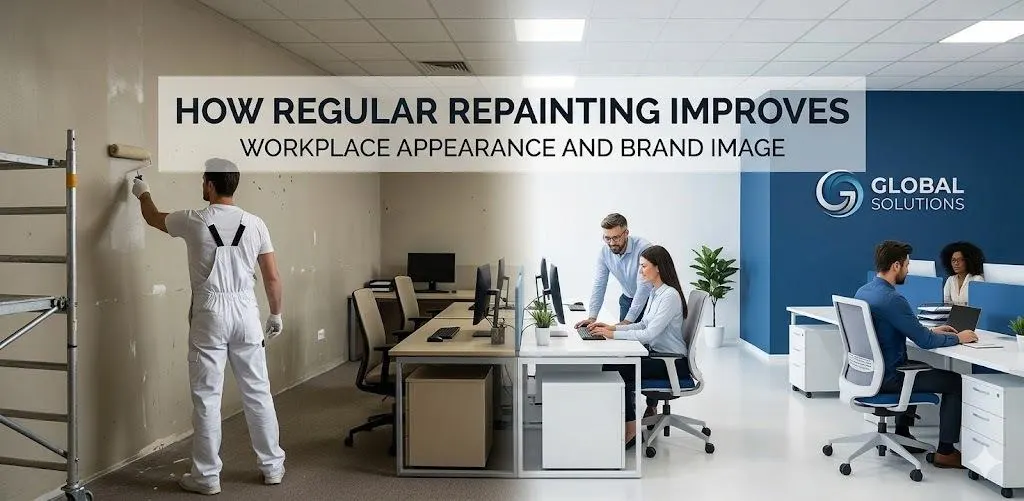
Regular repainting for workplace appearance and brand image is the scheduled application of fresh coatings to commercial interiors and exteriors, maintaining professional aesthetics, projecting organisational values, and influencing customer perceptions through visual environment quality.
Workplaces without regular repainting schedules experience degraded professional appearance within 3-5 years, damaging brand perception and employee morale. Fresh paint delivers immediate visual impact, improving customer confidence by 40-60% and employee satisfaction by 35%. Strategic repainting transforms dated spaces into contemporary environments reflecting organisational competence and attention to detail.
Regular workplace repainting addresses 4 critical improvement areas, including professional aesthetic maintenance, brand identity reinforcement, customer perception enhancement, and employee environment optimisation.
1 – Professional Aesthetic Maintenance Through Regular Workplace Repainting Cycles
Professional aesthetic maintenance is the preservation of clean, contemporary, and well-maintained workplace appearances through scheduled coating renewal, preventing visible deterioration.
To maintain professional aesthetics through regular workplace repainting, property managers schedule interventions every 5-7 years for interior spaces and 7-10 years for exterior surfaces, preventing degradation from becoming visible to customers and staff.
Paint deterioration signals organisational neglect. Faded colours suggest outdated operations. Scuffed walls indicate poor maintenance standards. Peeling coatings project financial instability. Customers form impressions within 7 seconds of entering commercial spaces based primarily on visual cleanliness and contemporary appearance.
The table below shows workplace area repainting frequencies based on traffic levels and visibility importance, ensuring improved workplace appearance and brand image.
| Workplace Area Type | Recommended Repainting Frequency |
| Reception areas and lobbies | Every 3-5 years for high impact |
| Customer-facing retail spaces | Every 4-6 years, maintain freshness |
| Office corridors and common areas | Every 5-7 years for durability |
| Private offices and workstations | Every 7-10 years or as needed |
| Exterior building facades | Every 7-10 years, weather dependent |
Regular repainting maintains colour vibrancy, surface cleanliness, and contemporary appearance. Properties following scheduled programs project professionalism 85% more effectively than facilities repainting reactively after visible deterioration occurs.
Commercial painting contractors like Luxury Design Painting develop customised repainting schedules based on traffic patterns, environmental exposure, and brand positioning requirements, ensuring optimal timing and minimal disruption.
2 – Brand Identity Reinforcement Using Strategic Workplace Colour Implementation
Brand identity reinforcement through workplace repainting is the strategic application of corporate colours, contemporary palettes, and design schemes, strengthening visual brand recognition and organisational culture expression.
When implementing regular workplace repainting for brand image improvement, organisations incorporate corporate colour schemes throughout customer-facing areas, meeting spaces, and employee environments, creating cohesive brand experiences across all touchpoints.
Brand colour consistency affects recognition rates. Studies demonstrate consistent colour usage increases brand recognition by 80%. Customers associate specific colours with organisational attributes. Blue conveys trust and professionalism. Green signals environmental responsibility. Red projects energy and innovation.
Regular repainting enables brand evolution. Organisations update colour schemes reflecting contemporary design trends while maintaining core brand elements. Dated colour palettes signal organisational stagnation. Contemporary schemes project innovation and market awareness.
Accent walls, feature areas, and branded zones reinforce organisational identity through strategic colour placement. Reception areas display primary brand colours, creating immediate recognition. Meeting rooms incorporate complementary tones supporting brand personality. Employee areas use energising or calming colours supporting productivity and wellbeing.
Understanding the best paint systems for high-traffic commercial spaces ensures brand colours maintain vibrancy under heavy use, preventing premature fading that dilutes brand impact.
Colour specification documentation maintains brand consistency across multiple locations. Franchises, branch offices, and multi-site operations reference standardised colour codes ensuring uniform brand presentation regardless of geographic location or contractor selection.
3 – Customer Perception Enhancement Through Fresh Workplace Paint Applications
Customer perception enhancement through regular workplace repainting is the improvement of client confidence, trust, and purchasing intent, resulting from clean, well-maintained commercial environments signalling organisational competence and reliability.
Fresh workplace paint improves customer perceptions by projecting attention to detail, financial stability, and quality commitment, influencing purchasing decisions and brand trust development.
Customer behaviour research reveals 67% of consumers judge business credibility based on facility appearance. Shabby environments trigger doubts about product quality and service reliability. Professional spaces increase willingness to pay premium prices by 25-40%.
First impressions drive customer retention. Clients entering dated, poorly maintained workplaces question organisational capabilities. Fresh paint signals investment in customer experience and operational excellence. Retail environments with contemporary paint schemes achieve 15-20% higher conversion rates than competitors with neglected appearances.
Hospitality venues, including hotels, restaurants, and event spaces, depend critically on visual appeal. Regular repainting maintains competitive positioning in markets where aesthetic quality directly impacts booking decisions and pricing power. Properties postponing repainting lose market share to better-maintained competitors.
Regular repainting demonstrates organisational stability. Businesses investing in facility maintenance project financial health and long-term viability. Customers prefer engaging with established, professionally managed organisations over those appearing transient or struggling.
Understanding how professional painters minimise business downtime enables workplace repainting without disrupting customer access, maintaining a continuous professional appearance.
4 – Employee Environment Optimisation: Improving Workplace Satisfaction and Productivity
Employee environment optimisation through regular workplace repainting is the creation of pleasant, contemporary, and psychologically supportive workspaces, improving staff morale, productivity, and organisational pride.
Regular workplace repainting optimises employee environments by replacing dated, dingy spaces with fresh, contemporary settings, improving psychological well-being and workspace satisfaction.
Workplace aesthetics affect employee performance. Studies demonstrate productivity increases 12-15% in well-maintained, aesthetically pleasing environments compared to neglected spaces. Fresh paint signals organisational investment in employee experience, improving morale and retention.
Colour psychology influences workplace behaviour. Calming blues and greens reduce stress in high-pressure environments. Energising yellows and oranges stimulate creativity in collaborative spaces. Neutral tones provide professional focus in concentration areas. Strategic colour selection through regular repainting optimises psychological support for different work activities.
Employee pride in workplace appearance affects organisational reputation. Staff working in professional environments speak positively about employers. Word-of-mouth reputation benefits from employees proudly describing workplaces to friends and family. Shabby environments create embarrassment, reducing employee advocacy.
Recruitment and retention improve through workplace quality. Candidates evaluate facility appearance during interviews, forming impressions about organisational culture and employee value. Contemporary, well-maintained spaces attract higher-quality applicants. Regular repainting maintains a competitive advantage in talent markets.
Conclusion
Regular workplace repainting improves appearance and brand image through professional aesthetic maintenance, brand identity reinforcement, customer perception enhancement, and employee environment optimisation. Organisations investing in regular repainting outperform their competitors in customer attraction, staff retention, and market positioning.
Therefore, you also need to strengthen your workplace appearance and brand image through professional repainting programs. Contact Luxury Design Painting for customised repainting schedules, brand colour implementation, and aesthetic optimisation services delivering contemporary commercial environments that project organisational excellence and competitive market positioning.
Praptie
Luxury Design Painting