
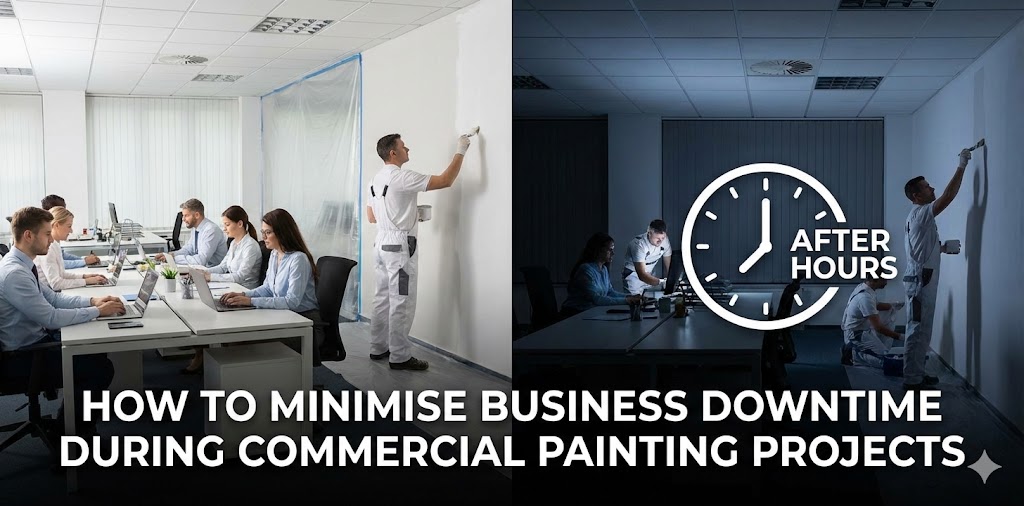
Every hour your business stays closed for painting costs you revenue, reputation, and customer momentum. Most commercial painting projects cause 3-7 days of disruption. Smart planning cuts that to zero.
Why?
Minimising business downtime during commercial painting projects requires strategic scheduling, fast-dry formulations, and phased work approaches that keep operations running. Professional painters use overnight shifts, weekend schedules, and low-disruption techniques that transform spaces without closing doors or losing a single day of revenue.
In this guide, you’re going to know that:
- Phased painting eliminates full closures completely
- Fast-dry paints cure in 2-4 hours between coats
- Overnight scheduling maintains daily operations
- Proper planning prevents costly last-minute delays
- Professional coordination minimises revenue loss
Why Poor Planning Causes Unnecessary Business Closures and Revenue Loss
Most commercial painting disruptions stem from inadequate planning, not painting itself.
Contractors who don’t understand business operations suggest full closures casually. They underestimate drying times. Ignore operational requirements. Create chaos unnecessarily.
Business downtime is any period when normal operations stop due to maintenance or renovations.
Every closed hour costs money directly. Lost sales. Wasted staff wages. Disappointed customers. Damaged reputation.
A retail store losing $5,000 daily revenue across a 5-day closure sacrifices $25,000. An office paying $15,000 weekly in staff wages wastes thousands if workers can’t access desks.
Smart planning eliminates these losses.
Phased Painting Approach: Working Room-by-Room to Maintain Operations
Phased painting divides projects into sections completed sequentially, while other areas remain operational.
This approach keeps businesses running throughout renovations entirely.
Paint one wing while staff work in another. Complete the ground floor while upper floors operate normally. Finish back-of-house while customer areas stay open.
The strategy requires careful coordination and planning:
- Map out which areas can close simultaneously
- Identify critical spaces needing constant access
- Schedule phases around business peak periods
- Coordinate logistics to avoid blocking access routes
- Maintain safety barriers between active and painted zones
Restaurants paint dining rooms in stages across different weeks. The office paint departments individually. Retail stores refresh sections overnight while staying open during the day.
Revenue continues. Operations proceed. Customers barely notice the transformation happening.
Fast-Dry Paint Formulations: The Game-Changer for Commercial Projects
Fast-dry paints use advanced chemistry, allowing recoating in 2-4 hours instead of 12-24 hours.
This timing difference transforms project scheduling completely.
Traditional paints need 24 hours between coats, minimum. Fast-dry products enable multiple coats in a single shift.
Friday 6 pm to Monday 6 am provides 60 hours. Fast-dry formulations complete:
- Full surface preparation on Friday evening
- First coat application Friday night
- Second coat application Saturday morning
- Third coat (if needed) Saturday evening
- Full cure by Monday morning opening
Staff return to fresh, odour-free spaces on Monday without losing a single workday.
The technology costs 10-15% more than standard paints. That premium pays back through maintained revenue and eliminated closure costs.
Overnight and Weekend Scheduling: Painting When Businesses Are Closed
Overnight painting happens between closing and opening hours, maintaining daily business operations.
This approach suits businesses operating standard hours perfectly.
| Business Type | Optimal Painting Schedule |
| Retail Stores | 6 pm-6 am overnight shifts weekdays |
| Office Buildings | Friday 5 pm to Monday 8 am weekends |
| Restaurants | 11 pm-9 am after dinner service |
| Medical Clinics | Saturday-Sunday full weekend blocks |
| Gyms/Fitness | Sunday-Thursday overnight (closed days) |
| Cafes/Bakeries | 2 pm-6 am afternoon/overnight combination |
Professional painters working overnight cost 15-25% more than standard rates. That premium saves thousands in lost revenue from daytime closures.
Calculate the real cost difference properly. Most businesses discover that overnight painting costs less overall than closing during peak hours.
Low-Odour and Low-VOC Products: Allowing Immediate Occupancy After Painting
Low-VOC paints contain fewer than 50 grams per litre of volatile organic compounds that cause odours.
Traditional high-VOC paints smell intensely for 5-7 days. Staff can’t work comfortably. Customers avoid the space entirely.
Low-VOC formulations smell minimally during application. Odours dissipate within 2-4 hours completely.
This difference allows immediate or next-day occupancy safely.
Paint Friday evening with low-VOC products. Air out overnight. Staff work normally on Monday morning with zero smell or health concerns.
The improved air quality prevents:
- Staff headaches and complaints
- Customer discomfort and departures
- Health and safety violations
- Lost productivity from poor conditions
Low-VOC products cost marginally more but eliminate closure extensions from lingering odours entirely.
Proper Ventilation Strategies That Accelerate Drying and Reduce Disruption
Ventilation is the process of exchanging indoor air with fresh outdoor air through mechanical or natural means.
Proper airflow accelerates paint drying dramatically while removing odours faster.
Professional ventilation strategies include:
- Industrial air movers are creating cross-flow ventilation
- HVAC system coordination for optimal air circulation
- Strategic window and door opening patterns
- Dehumidifiers reduce moisture that slows curing
- Air scrubbers remove paint particles and odours
These systems cut drying times by 30-50% compared to passive air drying.
Spaces dry faster. Odours clear quicker. Businesses reopen sooner.
The equipment costs $200-500 daily to hire. That investment saves days of closure costs worth thousands more.
Surface Preparation: Why Rushing This Stage Creates Longer Delays Later
Surface preparation includes cleaning, repairing, sanding, and priming before paint application.
This stage consumes 40-60% of project time, typically. Rushing it causes failures that extend timelines catastrophically.
Inadequate prep creates problems that appear within weeks:
- Paint peeling from contaminated surfaces
- Visible imperfections showing through topcoats
- Adhesion failures requiring complete stripping
- Uneven finishes demand additional coats
- Premature failure necessitating early repainting
Proper preparation takes longer initially but prevents these disasters completely.
Professional painters allocate adequate prep time upfront. They clean thoroughly. Repair properly. Prime correctly.
The extra day spent preparing saves weeks of remedial work later.
Coordinating With Other Trades: Avoiding Scheduling Conflicts That Cause Delays
Commercial renovations often involve multiple trades working simultaneously or sequentially.
Trade coordination means scheduling electricians, plumbers, painters, and other specialists to avoid conflicts.
Poor coordination creates expensive delays constantly:
- Electricians needing access after painting starts
- Plumbers cutting into freshly painted walls
- Carpet installers waiting for paint to dry
- Furniture delivery is conflicting with the wet paint
Professional project managers coordinate all trades beforehand. They establish logical sequences. Create detailed schedules. Communicate constantly.
Painters work after the electrical and plumbing rough-ins are complete. Finish before carpet or furniture installation begins. Coordinate with HVAC startups and other finishing trades.
Proper coordination prevents the stop-start delays that extend projects by weeks unnecessarily.
Protecting Furniture, Equipment, and Stock: Avoiding Damage That Stops Business
Drop sheets are protective coverings preventing paint splatter and damage to surfaces beneath.
Inadequate protection causes damage that stops business operations completely.
Paint-damaged computer equipment stops work instantly. Ruined stock creates inventory losses. Stained furniture requires replacement before reopening.
Professional painters protect everything thoroughly:
- Heavy-duty drop sheets cover all floors completely
- Plastic sheeting sealing furniture and equipment
- Masking film protecting windows and fixtures
- Barrier systems isolating work zones from active areas
- Proper containment prevents overspray migration
The protection takes hours to install properly. That time investment prevents thousands in damage claims and operational delays.
Cheap painters’ skip protection to save time. Their shortcuts cost you replacement expenses and extended closures.
Realistic Timeline Setting: Why Under-Promising and Over-Delivering Matters
The project timeline is the estimated duration from start to completion, including all phases.
Unrealistic timelines create planning disasters for businesses relying on reopening dates.
Contractors promising 3-day completions routinely run 5-7 days. Businesses plan reopenings around false promises. Lost revenue compounds when timelines slip repeatedly.
Professional painters provide conservative estimates accounting for contingencies:
- Weather delays for exterior sections
- Substrate issues discovered during prep
- Product availability and delivery timing
- Coordination requirements with other trades
- Proper curing time before full occupancy
Under-promising and over-delivering builds trust and prevents planning disasters.
A quoted 5-day project finishing in 4 days delights clients. A promised 3-day job taking 6 days destroys relationships and reputations.
Emergency Protocols: Planning for Unexpected Issues That Could Extend Timelines
Even perfectly planned projects encounter unexpected challenges occasionally.
| Potential Issue | Mitigation Strategy |
| Hidden substrate damage | Budget 10-15% contingency time/money |
| Weather delays (exterior) | Schedule buffer days into the timeline |
| Product delivery problems | Order materials 2 weeks in advance |
| Staff illness/absence | Maintain backup crew availability |
| Discovered safety issues | Halt work, address properly, resume |
| Client change requests | Document scope changes formally |
Contingency planning means preparing backup approaches for problems before they occur.
Professional contractors discuss potential issues upfront. They build contingency time into schedules. Maintain emergency contacts for suppliers and additional labour.
These preparations prevent minor hiccups from becoming major disasters that extend closures by weeks.
Why Professional Commercial Painters Minimise Downtime Better Than General Contractors
Commercial painting demands specialist knowledge beyond residential experience.
Professional commercial painters understand business operations intimately. They’ve coordinated hundreds of projects around operational requirements.
They know which scheduling approaches work for different business types.
- Which products allow the fastest occupancy?
- Which protection protocols prevent operational damage?
General contractors or residential painters lack this specialised experience. They underestimate commercial complexity. Create unnecessary disruptions. Extend timelines through poor planning.
The premium for commercial specialists pays back through maintained revenue and eliminated closure costs.
Luxury Design Painting specialises in zero-downtime commercial projects where maintaining operations matters critically. Get expert planning that keeps your business running while transforming your space beautifully and efficiently.
