
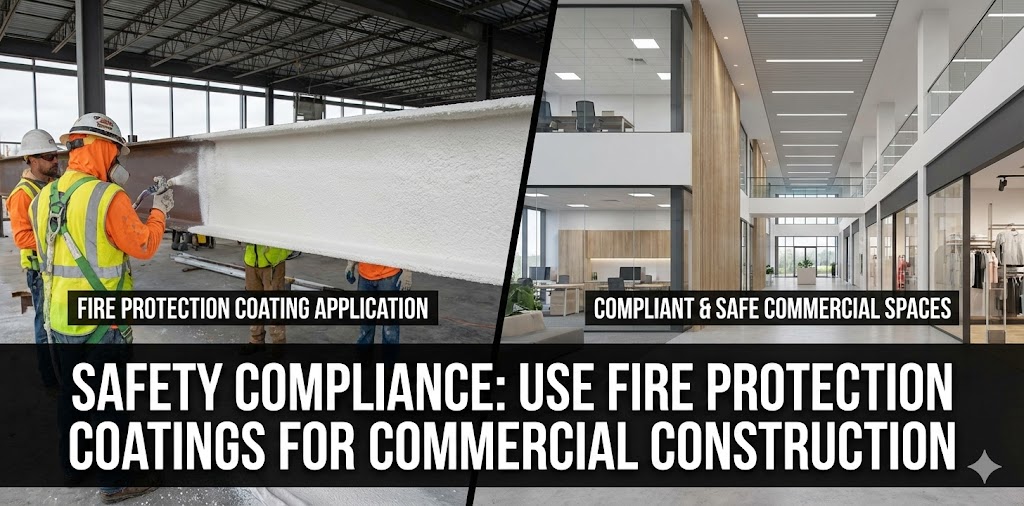
Fire kills faster than most building owners realise. Unprotected steel beams collapse within 15 minutes during structural fires. Fire protection coatings buy the evacuation time that saves lives, and keep you compliant with the Building Code of Australia requirements that aren’t optional.
Why?
Fire protection coatings for commercial construction provide critical fire resistance ratings required by Australian Building Codes, slowing structural collapse during fires while protecting evacuation routes.
These specialised intumescent and cementitious coatings maintain steel and timber integrity under extreme heat, meeting mandatory Fire Resistance Levels (FRL) that determine legal occupancy and insurance validity.
What you’ll discover:
- FRL ratings determine building compliance legally
- Intumescent coatings expand 50x under heat
- BCA mandates fire protection for most commercial buildings
- Non-compliance voids insurance and occupancy certificates
- Steel loses 50% strength at 550°C within minutes
What Fire Protection Coatings Actually Do During Structural Fires
Fire protection coatings are specialised paints that insulate structural elements against extreme heat during fires.
They work through two primary mechanisms, preventing structural collapse.
Intumescent coatings expand up to 50 times their original thickness when exposed to heat above 200°C.
This expansion creates an insulating char layer protecting steel or timber beneath. The char forms a barrier, slowing heat transfer dramatically.
Cementitious coatings use thick cement-based layers providing passive insulation through thermal mass.
Both systems achieve the same goal, maintaining structural integrity long enough for safe evacuation and firefighting operations.
Unprotected steel reaches critical failure temperatures within 10-15 minutes. Properly coated steel maintains strength for 60-240 minutes, depending on coating thickness and FRL requirements.
That time difference saves lives and buildings.
Understanding Fire Resistance Levels (FRL) and BCA Compliance Requirements
Fire Resistance Level (FRL) measures how long building elements resist fire in minutes. Expressed as structural adequacy/integrity/insulation.
The Building Code of Australia (BCA) mandates specific FRLs based on building classification, height, and occupancy type.
| Building Type | Typical FRL Requirement |
| Multi-storey commercial offices | 90/90/90 to 120/120/120 |
| Shopping centres and retail | 60/60/60 to 90/90/90 |
| Warehouses and industrial | 60/60/60 minimum |
| High-rise residential apartments | 120/120/120 to 180/180/180 |
The three numbers represent structural adequacy (load-bearing), integrity (fire spread prevention), and insulation (heat transmission) in minutes.
Non-compliance with BCA fire protection requirements prevents occupancy certificate issuance. Insurance becomes invalid. Legal liability increases catastrophically.
Fire protection coatings provide the only practical method of achieving required FRLs for exposed steel structures economically.
Intumescent vs Cementitious Coatings: Choosing the Right System
Intumescent coatings are thin-film systems (0.5-5mm) that swell dramatically under heat, creating protective char layers.
They suit architectural applications where aesthetics matter. They’re paintable, allowing colour matching. Applied like standard paint with spray or roller techniques.
Cementitious coatings are thick spray-applied cement-based systems (10-50mm) providing passive fire resistance through mass.
They suit concealed structural steel in service risers, car parks, or ceiling voids where appearance doesn’t matter.
Intumescent costs more per square metre but requires less thickness. Cementitious costs less but adds significant weight to structures.
Engineers specify which system suits your building’s structural and aesthetic requirements properly.
Application Requirements and Third-Party Certification Essentials
Fire protection coatings require certified applicators following manufacturer’s specifications exactly.
Third-party certification proves coating systems meet tested FRL ratings under laboratory fire conditions.
Only certified systems with proper application achieve the claimed fire resistance. Uncertified products or improper application fail catastrophically during actual fires.
Application requirements include:
- Blast cleaning steel to the specified surface profiles
- Precise coating thickness measurements across all surfaces
- Environmental controls during application and curing
- Third-party inspection verifying thickness compliance
- Certification documentation for building approval processes
Cutting corners during application voids all fire protection completely. The coating might look adequate, but it fails when tested by fire.
Use only licensed applicators with proven certification experience on similar commercial projects.
Maintenance and Inspection: Protecting Fire Ratings Long-Term
Fire protection coatings degrade over time without proper maintenance.
Annual inspections identify damage from impacts, moisture, or deterioration before fire protection fails.
Common degradation issues include:
- Physical damage from building modifications or maintenance
- Moisture penetration is causing coating disbondment
- UV degradation on exterior exposed applications
- Corrosion underneath coatings from inadequate prep
- Thickness loss from abrasion in high-traffic areas
Damaged sections require immediate repair, maintaining continuous fire protection across the entire structural elements.
Document inspection findings and repairs, maintaining building compliance records permanently.
Insurance assessors request fire protection maintenance records during claims. Missing documentation can void coverage completely.
Cost Considerations: Initial Investment vs Life-Safety Value
Fire protection coatings add 5-15% to structural steel finishing costs, typically.
That investment protects against total loss during fires. It maintains insurance validity. It ensures occupancy certificate approval.
Skipping fire protection to save costs creates massive liabilities:
- Building approval rejection is delaying projects for months
- Insurance coverage denial or premium increases
- Legal liability for non-compliant construction
- Occupant deaths or injuries during preventable collapses
- Total building loss from premature structural failure
The cost-benefit analysis overwhelmingly favours proper fire protection for all commercial construction meeting BCA requirements.
Conclusion
Fire Protection Isn’t Optional. It’s Life-Safety Engineering!
Fire protection coatings represent critical life-safety infrastructure, not decorative finishes. They maintain structural integrity during fires, providing evacuation time that prevents fatalities and catastrophic building collapse.
BCA compliance requirements exist because fire kills quickly when buildings fail prematurely. Intumescent and cementitious systems provide tested, certified protection that insurance, regulators, and occupants depend on absolutely.
Don’t compromise on fire protection coatings for your commercial construction project. Contact Luxury Design Painting for BCA-compliant fire protection solutions with certified application, third-party testing documentation, and comprehensive warranty coverage protecting your building investment and occupant safety.
