
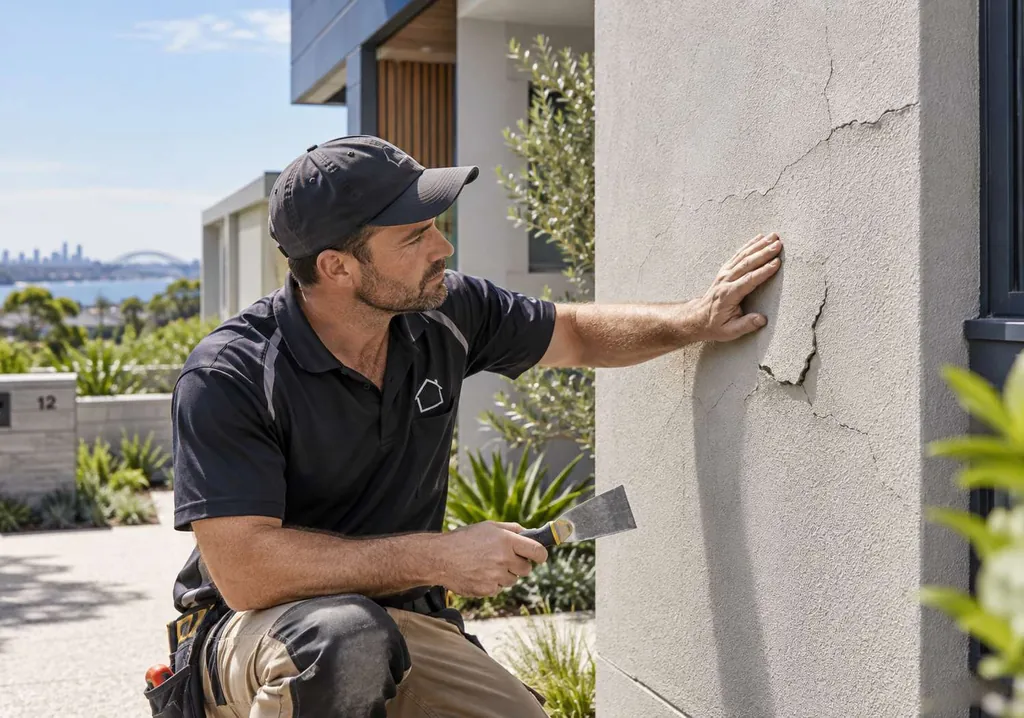
Drummy render is render that sounds hollow because part of the render layer has lost full adhesion to the wall or substrate underneath.
The outside surface can still look intact while a gap has developed between the render and the brick, block, masonry, or concrete behind it. In other cases, the hollow area appears alongside cracks, bulging, moisture damage, or loose sections.
The important question is not only whether the wall sounds hollow. You need to know why the bond has failed and how much of the render is affected before choosing a repair.
What Is Drummy Render?
Sound render forms a firm bond with the prepared surface underneath it.
Drummy render develops when part of this bond is lost. A void forms between the render and its substrate, producing a hollow or drum-like response when the affected area is professionally sounded.
You will also hear terms such as delaminated render, hollow render and blown render. They describe related conditions, but they do not mean the same thing.
A drummy section can remain localised to one part of a wall. Wider bond failure can affect a much larger section of a rendered façade.
That difference matters because a small isolated area and widespread delamination do not require the same repair approach.
Drummy vs Cracked vs Blown Render
Cracking, drummy areas and blown render can appear together, but each term describes something different.
| Condition | What It Means |
|---|---|
| Cracked render | A visible split has formed through the render or coating |
| Drummy render | An area sounds hollow, indicating possible loss of bond |
| Delaminated render | The render has separated from its substrate |
| Blown render | Trade term for badly debonded or failed render |
| Bulging render | Render is visibly moving outward from the wall |
A wall can therefore be both cracked and drummy. A crack can allow moisture entry, while movement or deterioration behind the surface can contribute to further loss of adhesion.
The visible condition needs to be assessed as part of the complete wall system.
What Causes Drummy Render?
What causes drummy render comes down to a failure of the bond between the render and the surface underneath it. Several conditions can create that failure.
Poor Surface Preparation
Render needs a clean, stable, and properly prepared substrate.
Dust, loose masonry particles, contamination, and weak existing material prevent the render from developing a reliable bond. If render is applied over an unsuitable surface, the finished wall can look sound while adhesion underneath remains weak.
This is why good surface preparation cannot be separated from rendering quality.
Render Drying Too Quickly
Render needs suitable application and curing conditions.
If the material loses moisture too quickly during its early curing stage, the finished system can develop weaker adhesion and cracking. Direct heat, strong drying conditions, and poor application control can contribute to the problem.
Poor Application or an Incompatible System
The render system needs to suit the substrate and the existing wall condition.
Poor bonding, unsuitable materials, excessive working of the render, or incorrect preparation of a previous repair can leave weak areas behind the finished surface.
Adding another layer over an unstable base does not correct the original failure.
Moisture Behind the Render
Water can contribute to deterioration behind a rendered surface.
Entry points include cracks, failed sealants, leaking flashing, deteriorated exterior coatings and other defects that allow water to reach the wall system.
The moisture source needs to be found and repaired before damaged render is reinstated. Otherwise, the same conditions remain behind the new finish.
Movement in the Wall
Movement within masonry, concrete, or surrounding building components can transfer stress into the render.
The result can include cracking followed by local loss of adhesion.
Movement needs investigation before resurfacing because replacing the visible render alone does not stop an active underlying problem.
Age and Previous Repairs
Older Sydney homes can contain original cement render, later patches, repaired cracks and several generations of exterior paint coatings.
These areas do not all deteriorate at the same rate.
Previous patches can also separate where their preparation or compatibility with the surrounding material was poor.
How Can You Tell If Render Is Drummy?
A hollow sound is one clue, but it should not be considered in isolation.
Before testing, inspect the wall for cracking, bulging, loose edges, previous repairs separating from the surrounding render, and areas that visibly move.
Professionals can then carefully sound sections of the surface and compare suspect areas with known sound sections. A noticeable change in response helps map areas where adhesion has potentially been lost.
This assessment also helps establish whether the problem is one small patch or extends across a larger part of the façade.
Do not aggressively hit suspect render yourself. Material that has already lost its bond can be unstable.
Most importantly, a hollow response identifies a possible bond problem, not its cause. Moisture, substrate condition, movement, and the surrounding render still need assessment.
Can Drummy Render Be Repaired Without Removing It?
Drummy render does not always require complete removal of an entire façade, but Luxury Design Painting’s normal repair approach starts with assessment of the failed area, removal of unsound render where required, preparation of the exposed substrate, and reinstatement with a compatible render system.
Specialist rebonding or injection methods can exist for selected situations, but they are not a standard repair approach for every hollow area and would depend on the existing render, substrate, extent of debonding, moisture conditions and the cause of failure.
The existing render first needs to remain physically suitable for retention.
The assessment also needs to consider how far the debonding extends, the condition of the substrate, whether moisture remains active, what originally caused the failure, and whether the selected repair system can properly reach and bond the affected area.
This distinction is important.
Reattaching a render layer without correcting an active water-entry problem does not solve the moisture source. The same principle applies when movement or a weak substrate caused the original failure.
Where the render is extensively cracked, bulging, deteriorated, moisture-damaged or widely delaminated, removing the failed material provides access to the substrate and allows the underlying problem to be addressed.
The repair method should follow the diagnosis, rather than choosing a repair method simply because the wall sounds hollow.
When Does Drummy Render Need to Be Removed?
Loose render repair requires removal where the existing material cannot provide a stable base for a reliable repair.
Removal becomes appropriate when render is visibly bulging, loose at the edges, extensively cracked, or deteriorated. Widespread hollow areas, continuing moisture damage, and repeated failure of previous patches also point towards a broader remedial approach.
The purpose is not to remove sound render unnecessarily.
The failed area should first be mapped. Unsound material can then be removed back to suitable edges, allowing the exposed substrate to be inspected and repaired.
The sequence is:
Map the failure > Remove unsound render > Inspect the substrate > Correct the cause > Prepare the surface > Re-render > Match the texture > Recoat
Luxury Design Painting's render repair in Sydney covers cracked, drummy and blown render, including removal of failed sections, substrate preparation and reinstatement using a compatible rendering system.
Can You Paint Over Drummy Render?
No coating can restore a failed render bond.
Paint protects and finishes a sound surface. It does not reconnect detached render to masonry, repair a damaged substrate, or stabilise loose material.
The same applies when moisture is causing deterioration behind the wall. Painting the exterior without fixing the moisture pathway leaves the underlying problem in place.
Painting becomes part of the solution after the remedial work.
Once failed render has been repaired, the substrate restored and the new render properly finished, a compatible coating system can protect the surface and help blend the repaired section with the surrounding façade.
That order matters:
Cause > Substrate > Render > Finish > Paint
Not:
Hollow render > Paint
Does All Hollow Render Need Replacing?
No. A localised hollow area does not automatically mean an entire rendered façade needs to be stripped.
The extent of the bond failure determines the next step.
A small area surrounded by firmly bonded render can support a localised repair when the substrate remains stable, and the cause has been corrected.
Widespread hollow zones need a broader assessment. The same applies when the wall contains extensive cracking, moisture damage, bulging sections or repeated failed patches.
Depending on the findings, the correct response can range from monitoring a stable area to local removal and re-rendering, or broader façade remediation. Specialist rebonding methods may be considered separately in selected circumstances where the existing system is suitable for that approach.
The objective is to retain sound material and remove failed material where required.
How Is Failed Render Professionally Repaired?
Professional rendering and remedial repairs start by determining where the failure ends and sound material begins.
1. Map the Affected Areas
The wall is inspected and sounded to identify the extent of hollow, loose, or delaminated render.
2. Find the Cause
Moisture entry, movement, poor adhesion, substrate deterioration, and previous repair failure need to be considered before new material is installed.
3. Remove Unstable Material
Failed render is removed where required, working back to sound areas rather than simply covering loose material.
4. Repair and Prepare the Substrate
The exposed surface is cleaned and repaired so the replacement system receives a stable, compatible base.
5. Apply the Compatible Render System
The replacement render needs to suit the substrate and surrounding system. Cement and acrylic rendering systems have different characteristics and applications.
6. Match the Texture and Profile
A good remedial repair needs to blend with the surrounding façade rather than leave an obvious flat patch.
7. Apply the Finishing Coating
Once the render has satisfied its finishing requirements, the appropriate coating system completes and protects the repaired surface.
Luxury Design Painting's rendering and remedial repairs follow this cause-first approach so failed render is not simply hidden beneath another surface treatment.
How Can You Reduce the Risk of Render Becoming Drummy?
Preventing render delamination starts before the render is applied.
The substrate needs to be sound, clean, and free from loose material and contamination. The selected rendering system must also be compatible with that substrate and installed under appropriate conditions.
After installation, keep the exterior envelope maintained.
Repair cracks rather than allowing them to remain open. Address failed sealants, flashing defects, and other water-entry points. Maintain exterior coatings so they continue protecting the rendered surface.
Movement also needs attention. If cracking repeatedly returns because something underneath is moving, another surface patch does not remove that movement.
Good render performance therefore depends on the complete system:
Stable substrate + correct preparation + compatible render + controlled application + moisture management + ongoing maintenance
When Should a Sydney Homeowner Get Drummy Render Assessed?
Arrange an assessment when the hollow area is spreading, cracking accompanies the hollow response, or the render has started bulging or moving.
Moisture staining, loose edges, falling pieces, and repairs that repeatedly fail are stronger reasons to investigate the wall rather than patch it again.
Large rendered façades also deserve assessment when multiple hollow areas appear across different sections.
For homeowners looking for professional render repair in Sydney, Luxury Design Painting can assess the affected areas, determine the repair scope, remove failed material where required, and restore the substrate, render, and finished coating as one remedial system.
Frequently Asked Questions
What does drummy render mean?
Drummy render means an area produces a hollow response because the render has potentially lost full adhesion to the substrate underneath.
What causes drummy render?
Poor substrate preparation, rapid drying, application problems, moisture, movement, and deterioration of the render-to-substrate bond can all cause drummy render.
Is drummy render dangerous?
A small hollow area does not automatically indicate a structural problem. Loose, bulging or extensively debonded render can detach and needs prompt assessment.
Can drummy render be repaired without removal?
Sometimes, but the repair method depends on the condition of the render and substrate. Luxury Design Painting’s normal approach is to assess the affected area, remove failed material where required, prepare the substrate and reinstate it with a compatible render system. Specialist rebonding methods may only suit selected situations after assessment.
Does all drummy render need replacing?
No. Localised failure can support local repair when the surrounding render and substrate remain sound. Widespread failure requires a broader remedial assessment.
Can you paint over drummy render?
Paint does not restore adhesion between render and its substrate. Failed material needs the appropriate repair before the wall is recoated.
Does Your Render Sound Hollow or Feel Loose?
A hollow sound tells you the render has potentially lost its bond. It does not tell you why.
The right repair depends on how much render has delaminated, whether the substrate remains sound, and whether moisture, movement, or another active problem is contributing to the failure.
That is why proper loose render repair starts with assessment rather than another patch or coat of paint.
Luxury Design Painting's team brings more than 30 years of experience across painting, rendering and remedial work in Sydney. Our team can identify failed areas, remove unsound render where required, repair and prepare the substrate, reinstate the compatible render system and complete the finished coating.
Sydney homeowners and property managers can rely on Luxury Design Painting for professional render repair, from assessment and substrate preparation through to compatible reinstatement and finishing. Request a Rendering & Remedial assessment today.
admin
Luxury Design Painting