
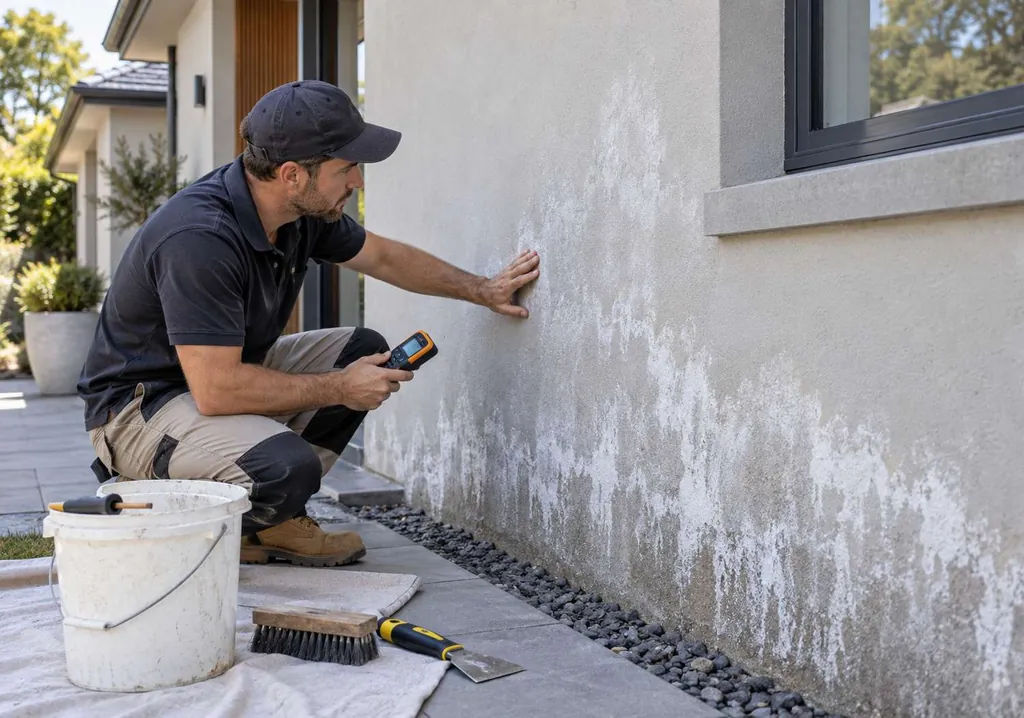
Efflorescence on rendered walls is the white, chalky or crystalline salt deposit left behind when moisture moves through masonry or render and evaporates at the surface.
The visible salt is only the final part of the process. The more important question is where the moisture came from and whether it has stopped.
New render can develop short-term efflorescence as residual construction moisture leaves the substrate. On an older Sydney façade, repeated white deposits alongside cracking, dampness, peeling paint or loose render need further investigation before cleaning or repainting.
What Is Efflorescence on Rendered Walls?
Efflorescence develops through a simple three-part process.
First, soluble mineral salts exist within render, mortar, concrete, brick or other masonry materials.
Second, moisture enters or remains within the wall and dissolves some of those salts.
Third, that moisture travels towards an exposed surface. The water evaporates, but the dissolved minerals cannot evaporate with it. They remain as a white, powdery or crystalline deposit.
This is why simply brushing away the white material does not explain what is happening inside the wall.
Efflorescence itself does not automatically mean the render has failed. The condition of the render, paint coating, and substrate needs to be considered separately.
What Causes Efflorescence on Walls?
What causes efflorescence on walls is moisture transporting soluble salts through the building material. The source of that moisture differs between properties.
Residual Moisture in New Render or Masonry
New cement-based render and masonry contain moisture from construction and curing.
As that moisture leaves the wall, it can transport salts to the surface. This form of efflorescence can stop once the material has properly dried and the available construction moisture has dissipated.
Recurring deposits on an established wall need a different investigation.
Cracks in Render
Cracks can create a pathway for rainwater to enter a rendered wall.
Small surface cracks and larger cracks do not have the same significance, so the crack itself also needs assessment. Water can enter somewhere else and travel through the wall before appearing at the efflorescence location.
Failed Waterproofing
Waterproofing defects can create persistent moisture problems around balconies, terraces, planter boxes and parapets.
If water continues entering from these areas, cleaning the salts from the wall below does not stop the process.
Leaks From Above
Roof details, flashing, drainage systems, balconies and pipework can allow water to reach masonry.
The visible deposit can appear below or away from the actual entry point because moisture follows available paths through the building.
Moisture From Below
Poor site drainage, water pooling against masonry, soil contact, and rising moisture can introduce water from lower sections of a wall.
The moisture pathway needs to be identified before selecting a repair or coating system.
Does Efflorescence Always Mean There Is a Leak?
No. Persistent efflorescence deserves investigation, but a visible deposit does not automatically prove there is a building leak.
Fresh render and new masonry can release residual moisture as they dry. If the wall dries correctly and the deposits stop returning, the issue can be temporary.
Recurring efflorescence is different.
Repeated white deposits, damp staining, blistering or peeling paint, cracking and deteriorating render indicate that moisture movement has not been resolved.
The correct response is to find the moisture pathway rather than assume the white salts themselves are the main defect.
Is White Salt on a Sydney Rendered Wall Always Efflorescence?
No. This distinction is especially important for coastal Sydney properties.
Airborne sea salt can settle directly onto an exterior wall. That is surface contamination arriving from outside.
Efflorescence travels through the wall. Moisture dissolves salts within the masonry or render, carries them towards the surface, and leaves them behind after evaporation.
The two conditions can look similar.
Location, exposure, moisture patterns and the condition of the surrounding wall help determine what is happening.
For homes exposed to marine conditions, our guide to protecting rendered walls in coastal Sydney explains how salt, moisture, coatings and maintenance interact.
Efflorescence vs Mould: How Can You Tell the Difference?
Efflorescence and mould both appear on moisture-affected walls, but they are different problems.
| Feature | Efflorescence | Mould |
|---|---|---|
| Cause | Mineral salts carried by moisture | Fungal growth supported by moisture |
| Appearance | White, chalky or crystalline | Black, green, grey or varied |
| Smell | No characteristic musty smell | Can have a musty smell |
| Surface | Dry or powdery deposits | Patchy, fuzzy, or slimy growth |
| Response | Find moisture source and remove salts | Find moisture source and remediate growth |
Appearance alone is not enough to diagnose every wall. Professional assessment is the better option where the material or moisture source is unclear.
Can Efflorescence Damage Render or Paint?
Surface efflorescence does not automatically mean the render underneath has failed.
The concern increases when salt crystallisation and moisture affect the coating system or occur alongside other defects.
Paint can start blistering, peeling or flaking. The surface beneath it can become weak or friable. Continued moisture can also contribute to deterioration within an already damaged rendered wall.
Look beyond the white deposit.
Cracking, hollow areas, bulging render, loose sections and repeated coating failure indicate that cleaning alone is no longer enough.
How Do You Remove Efflorescence From Render?
To remove efflorescence from render, deal with the moisture condition first and use a cleaning method compatible with the existing surface.
1. Assess the Moisture
Confirm whether the wall is drying or whether water is still entering it. Repeated cleaning is ineffective while the same moisture pathway remains active.
2. Remove Loose Dry Deposits
Loose salts can be removed from a dry, sound surface using an appropriate dry-cleaning method that does not damage the render.
3. Use a Compatible Cleaner Where Required
More stubborn deposits require a cleaner designed for the surface involved. Follow the product manufacturer's preparation, dilution and application requirements.
4. Rinse or Neutralise as Directed
Complete any rinsing or neutralising procedure specified for the cleaning system.
5. Allow the Wall to Dry
The surface needs adequate drying before further repairs, primers or coatings are considered.
6. Reassess the Wall
Check whether deposits return and inspect the render and existing coating for deterioration.
Avoid aggressive DIY acid treatments. Strong acidic cleaners can etch render, masonry and surrounding finishes when used incorrectly.
Why Does Efflorescence Keep Coming Back?
Recurring efflorescence means the process that created the deposit is continuing.
The cycle is straightforward:
Water enters > Salts dissolve > Moisture moves through the wall > Water evaporates > Salts remain > Surface is cleaned > Water enters again
Cleaning only removes the salts that have already reached the surface.
A failed balcony waterproofing detail, leaking flashing, render crack, drainage defect, roof problem, plumbing issue, or rising moisture can continue supplying water after the wall has been cleaned.
The moisture source therefore needs to be traced rather than repeatedly treating the visible white material.
Cracking deserves particular attention because it can form one of several water-entry pathways.
Can You Paint Over Efflorescence?
Do not paint over active efflorescence or a wall that still has an unresolved moisture problem.
Loose salt creates a poor surface for coating adhesion. Continued moisture movement can also transport new salts behind the fresh paint, contributing to blistering, peeling, and coating failure.
A moisture-barrier coating is not a substitute for diagnosing water entry.
The correct sequence is:
Find the moisture source > Remove salts > Repair defects > Allow appropriate drying > Prepare the surface > Apply compatible primer or sealer > Repaint
Paint belongs at the end of the repair system, not at the beginning.
When Does Efflorescence Need Render Repair?
Cleaning can be enough when the render remains firmly bonded, the deposit is superficial, and the source of excess moisture has stopped.
Remedial work becomes necessary when the surrounding wall has also deteriorated.
Warning signs include cracking, repeated paint failure, delaminating render, hollow or drummy areas, loose sections and moisture-damaged substrate.
These defects need to be addressed before the façade receives its final coating.
Luxury Design Painting provides render repair in Sydney for water-damaged, cracked, drummy and failed render. The remedial process addresses failed material and the substrate before compatible render and coating systems are reinstated.
What If the Render Also Sounds Hollow?
A hollow or drum-like response indicates possible loss of adhesion between the render and the substrate.
Efflorescence and hollow render appearing together deserve closer investigation because moisture can exist alongside render delamination. The hollow condition can also have another cause, including poor original preparation, movement, or application failure.
A hollow response therefore identifies another symptom. It does not prove moisture caused the bond failure.
How Is Moisture-Damaged Render Professionally Repaired?
Professional repair works from the cause outward rather than covering the visible damage.
1. Identify the Moisture Path
The source or pathway of water movement is investigated.
2. Stop or Control the Source
Waterproofing, drainage, cracks, or other contributing defects need appropriate rectification.
3. Map the Damage
Loose coatings, hollow render and failed sections are identified.
4. Remove Unsound Material
Failed material is removed where required to expose a suitable repair area.
5. Repair the Substrate
The underlying surface is cleaned, stabilised and repaired before reinstatement.
6. Reinstate Compatible Render
A suitable rendering system is applied and matched to the surrounding texture and profile.
7. Allow Correct Drying and Curing
The repaired system needs to satisfy its drying or curing requirements before finishing.
8. Complete the Coating System
Compatible finishing products restore and protect the repaired façade.
Luxury Design Painting's rendering and remedial repairs follow this cause-first approach instead of simply painting over moisture-related deterioration.
How Can You Reduce the Risk of Efflorescence Returning?
Keep water from repeatedly entering or travelling through the wall.
Maintain gutters and downpipes. Repair failed sealants and render cracks. Inspect balcony edges, parapets and waterproofing details when staining appears below them. Keep ground drainage working so water does not remain against lower masonry.
New cementitious surfaces also need appropriate drying and curing before incompatible finishes are applied.
Most importantly, do not try to trap an active moisture problem behind another coating.
The strongest long-term approach combines water management, sound render, compatible coatings and regular exterior maintenance.
Frequently Asked Questions
What causes efflorescence on rendered walls?
Moisture dissolves soluble salts within render or masonry and transports them to the surface. White deposits remain after the water evaporates.
Is efflorescence a sign of water damage?
Not always. New render can show deposits while residual construction moisture dries. Recurring efflorescence indicates continued moisture movement that needs investigation.
Can you paint over efflorescence?
Not while active salts or unresolved moisture remain. Correct the cause, remove the deposits, and properly prepare the wall before repainting.
Why does efflorescence return after cleaning?
Cleaning removes existing surface salts but does not stop moisture. If water continues moving through the wall, more salts reach the surface.
Can cracks in render cause efflorescence?
Cracks can provide a pathway for water entry. The actual source can also be flashing, waterproofing, drainage, balconies, plumbing, or another building defect.
White Salt Deposits Keep Coming Back on Your Render?
Recurring efflorescence should be treated as evidence of moisture movement rather than simply a white stain to cover.
The correct response is to understand where the water is coming from, check the condition of the render and substrate, complete the required repairs, and only then restore the coating system.
If repeated deposits appear alongside cracking, hollow render, or peeling paint, Luxury Design Painting provides professional render repair in Sydney with a cause-first approach to remedial work.
Request a Render & Remedial Assessment to identify the problem and restore the wall with a repair system suited to its actual condition.
admin
Luxury Design Painting