
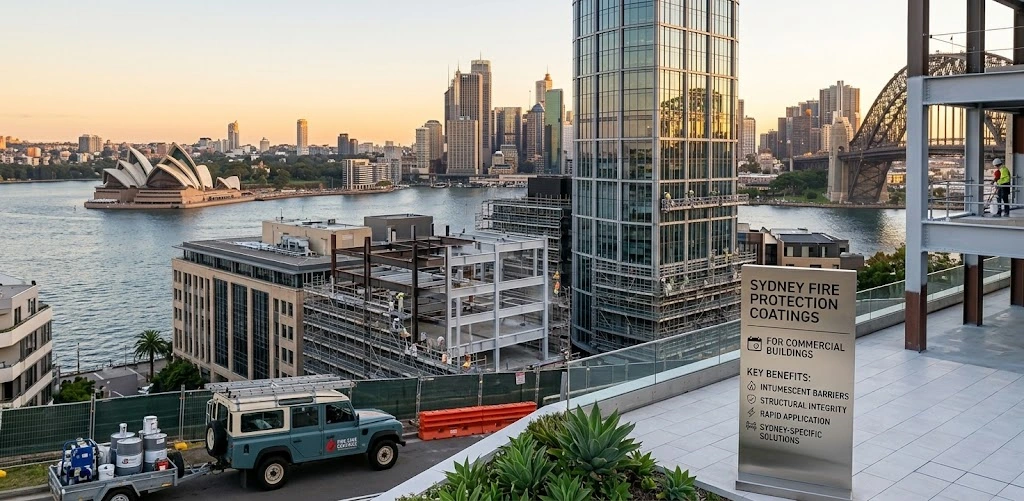
Fire protection coatings for commercial buildings in Sydney are specialised paints and coatings applied to walls, ceilings, steel beams, and other structural surfaces that slow the spread of fire, buy time for evacuation, and protect a building’s structural frame from collapse during a fire emergency.
Think of fire protection coatings as a building’s invisible shield. Without them, fires spread faster, structures weaken more quickly, and people have less time to get out safely. Sydney commercial buildings, including offices, retail stores, warehouses, and apartment complexes, are legally required to have these coatings installed and maintained to meet Australian safety standards.
What you’ll learn in this article:
- What fire protection coatings are and why buildings need them
- Which Australian standards govern these coatings
- The two main coating types and where each one belongs
- What NSW law requires of commercial building owners
- How fire protection coatings work alongside regular commercial painting
- How to choose the right contractor for this specialised work
What Are Fire Protection Coatings and Why Do They Matter
Fire protection coatings are specialised building products applied to structural surfaces that activate during fires, slowing heat transfer and buying critical time for occupants to evacuate safely.
Without fire protection coatings on a building’s steel structure, fires can cause structural collapse surprisingly quickly, before emergency services arrive. Steel beams, columns, and frames look strong under normal conditions but weaken rapidly under intense heat. Fire protection coatings slow this process down significantly.
Fire protection coatings serve 3 practical purposes in Sydney commercial buildings.
1 – Keeping the structure standing long enough for everyone inside to get out safely. This applies to steel beams, concrete floors, timber elements, and load-bearing walls throughout the building.
2 – Stopping fire from spreading between rooms, floors, and sections of the building by sealing gaps, joints, and penetrations where fire and smoke travel fastest.
3 – Protecting escape routes, including corridors, stairwells, and emergency exits, so people can actually use them during an emergency rather than finding them blocked by fire or smoke.
Every Sydney commercial building sits within a building classification under the National Construction Code. Offices, shops, warehouses, hospitals, and mixed-use buildings each carry different fire resistance requirements. The coating systems installed must match what the building classification demands. There is no one-size-fits-all solution.
Buildings without compliant fire protection coatings face serious consequences: legal violations, voided insurance policies, and genuine structural safety risks during fire events. This isn’t a technicality. It’s a core building safety requirement.
Understanding safety compliance requirements for commercial construction helps Sydney building owners and managers approach fire protection coating obligations with confidence.
Australian Standards for Fire Protection Coatings (AS 1530)
AS 1530 is the Australian standard that tests and certifies fire protection coating products, confirming they perform as claimed before being approved for use in Australian commercial buildings.
Before any fire protection coating product reaches a Sydney building, it must pass independent laboratory testing confirming it actually works under real fire conditions. AS 1530 sets the rules for how these tests happen and what products must prove before receiving certification.
The standard covers several testing areas: how materials behave when exposed to fire, how quickly flames spread across surfaces, how much smoke products generate, and critically, how long structural elements maintain their strength and stability when coated with specific products.
Products passing AS 1530 testing receive certification confirming their fire resistance performance. This certification only applies to specific products, applied at specific thicknesses, to specific surfaces.
Changing any of those variables, using a different product, applying it thinner, or using it on a different surface than tested, removes the certification and creates a non-compliant installation.
Testing must be conducted by NATA-accredited laboratories, independent organisations verified to meet testing standards. Always request NATA test certificates for fire protection products specified for your Sydney building. Without these certificates, you cannot confirm the product you’re paying for actually does what it claims.
Keep all fire protection coating documentation throughout the building’s ownership. These records are required during building inspections, insurance reviews, and property sales. Missing documentation creates compliance problems regardless of how well the actual coating was installed.
Intumescent vs Cementitious Fire Protection Systems
Intumescent coatings look like normal paint during everyday conditions but swell dramatically when exposed to fire heat, creating a thick insulating layer protecting the structure underneath.
The two main types of fire protection coatings used in Sydney commercial buildings work differently, look different, and suit different situations.
Intumescent coatings
Intumescent coatings are the more common choice when appearance matters. Applied thinly like regular paint, they look completely normal on steel beams, columns, and architectural structural elements. During a fire, heat triggers a chemical reaction, causing the coating to expand significantly, forming a thick, insulating foam-like char layer that protects the steel beneath from heat damage.
Intumescent coatings suit Sydney commercial spaces, including modern offices with exposed architectural steel, retail environments where structural elements are visible, heritage buildings requiring minimal thickness, carpark structures, and warehouse facilities with exposed roof steel. When structural elements form part of a building’s design aesthetic, intumescent systems protect without compromising appearance.
Cementitious coatings
Cementitious coatings are thicker, bulkier spray or trowel-applied materials used where appearance is less important but protection performance is the priority. Plant rooms, service areas, heavily industrial spaces, and building sections never seen by the public typically use cementitious systems.
| System Type | Fire Resistance Period | Best Applications |
| Thin-film intumescent | 30-60 minutes | Offices, retail, exposed architectural steel |
| Thick-film intumescent | 90-120 minutes | High-rise commercial, hospitals |
| Spray cementitious | 60-180 minutes | Plant rooms, service areas, industrial |
| Board cementitious | 120-240 minutes | Critical infrastructure, high-risk facilities |
Choosing between these systems requires input from a qualified fire engineer or building certifier who understands your specific building classification, structural configuration, and fire resistance obligations.
NSW Building Code Compliance Requirements
NSW law requires commercial building owners to install certified fire protection coatings, maintain them properly, and submit annual documentation confirming their fire safety systems remain functional and compliant.
The National Construction Code specifies fire resistance requirements for every commercial building classification in NSW. Different buildings need different levels of fire protection based on their height, how many people occupy them, and what they’re used for. A small single-storey retail shop has different requirements than a high-rise office building or a hospital.
Three NSW-specific laws add compliance obligations on top of national code requirements.
- The Building Products (Safety) Act 2017
The Building Products (Safety) Act 2017 makes it illegal to use fire protection products that haven’t been properly certified. Using non-certified products, even unknowingly, creates serious legal exposure for building owners.
- The Environmental Planning and Assessment Act 1979
The Environmental Planning and Assessment Act 1979 ties fire safety measures, including coating systems, to development consent conditions. Buildings must maintain compliance with these conditions throughout their operational life.
- The Strata Schemes Management Act 2015
The Strata Schemes Management Act 2015 places fire safety maintenance obligations directly on owners’ corporations managing strata commercial properties. Strata committees cannot delegate or ignore these responsibilities.
Every year, Sydney commercial building owners must submit fire safety statements to their local council and NSW Fire and Rescue confirming all fire safety systems, including protective coatings, remain compliant. Missing this submission creates regulatory problems regardless of the actual condition of your building’s fire protection.
Buildings also cannot legally be occupied without occupation certificates confirming that fire protection installation has been inspected and approved by accredited certifiers.
Understanding strata property paint warranties and compliance provides additional context for strata commercial building managers navigating fire safety documentation requirements.
Integration with Commercial Painting Specifications
Fire protection coatings and regular decorative commercial painting must work together in a specific order. Getting this sequence wrong can void fire protection certification regardless of product quality.
Many Sydney building owners don’t realise that fire protection coatings and standard commercial painting aren’t completely separate jobs. They interact directly. The primers applied before fire protection coatings, and the decorative paints applied over them, must be compatible with the certified fire protection system. Otherwise, the certification becomes invalid.
This integration creates 4 practical requirements for Sydney commercial painting projects involving fire protection work.
- Primer selection
Primer selection must be confirmed to be compatible with the specific fire protection coating being used. A primer that works perfectly for standard commercial painting might completely undermine fire protection coating performance if applied incorrectly in this context.
- Topcoat selection
Topcoat selection for the decorative paint applied over intumescent systems must come from the manufacturer’s approved product list. The decorative paint cannot interfere with the coating’s ability to expand during a fire, and not all paints allow this.
- Application order
Application order follows a strict sequence: surface preparation and primer, fire protection coating application, adequate drying time, then decorative topcoat within approved thickness limits. Skipping or reordering any stage creates compliance problems.
- Colour and finish selection
Colour and finish selection must work within the constraints of approved topcoat products. Architects and designers should confirm their colour specifications are achievable within certified system requirements before finalising specifications.
The simplest way to manage these compatibility requirements is to engage a single contractor capable of delivering both fire protection and decorative painting work. Single-contractor delivery eliminates the blame-shifting between separate teams when compatibility problems arise.
Low-VOC and non-toxic paints for commercial interiors must also be checked for compatibility with fire protection systems before specification in Sydney buildings, prioritising both safety and indoor air quality.
Selecting Certified Fire Protection Coating Contractors in Sydney
The right fire protection coating contractor holds product-specific manufacturer certification, carries adequate insurance for life-safety work, and provides complete compliance documentation after project completion. Not just a finished paint job.
Choosing the wrong contractor for fire protection coating work creates problems that go well beyond a poor paint finish. Non-compliant installations require complete removal and reinstallation (entirely at building owner expense) with no recourse against contractors who lacked proper certification or insurance.
Evaluate fire protection coating contractors across 6 areas before engagement.
- Manufacturer certification
Manufacturer certification proves the contractor has been trained specifically on the products being installed. General painting experience and qualifications don’t transfer to fire protection work. Ask for product-specific training certificates.
- Relevant project experience
Relevant project experience in Sydney commercial buildings similar to yours demonstrates practical knowledge beyond classroom training. Request references from previous clients or building certifiers who can confirm the quality and compliance of completed installations.
- Insurance coverage
Insurance coverage for fire protection work must go beyond standard commercial painting policies. Life-safety system installation carries different liability profiles; confirm that public liability, products liability, and professional indemnity coverage are all in place.
- Quality control procedures
Quality control procedures confirm that the contractor monitors application quality throughout installation rather than simply finishing and leaving. Ask how they monitor and document coating thickness and application quality during the project.
- Documentation packages
Documentation packages provided after project completion should include all NATA test certificates, application records, photographic documentation, and as-installed drawings needed for your annual fire safety statement submissions.
- WHS documentation
WHS documentation specific to fire protection coating installation, not just general painting safety plans, confirms the contractor understands the specific hazards involved in this work.
Selecting the best commercial painters for fire protection work requires asking these additional questions beyond the standard contractor evaluation process.
Fire protection coating maintenance creates an ongoing relationship with your chosen contractor. Annual condition inspections and minor repairs maintain compliance documentation currency between full recoating cycles. Choose contractors offering ongoing maintenance support rather than installation-only services.
Conclusion
Compliance today prevents catastrophe tomorrow!
Sydney building owners who view fire protection coating compliance as paperwork rather than people-protection are misunderstanding what these systems actually do. They don’t exist to satisfy regulators. They exist because buildings without them put lives at risk during fire emergencies.
The paperwork simply proves the protection is real.
Buildings that maintain proper fire protection coatings, keep complete documentation, and submit annual fire safety statements aren’t doing extra work. They’re doing the minimum required to operate a commercial building responsibly in Sydney, and protecting everyone inside from the consequences of cutting corners on something that genuinely matters.
Protect your Sydney commercial building with certified fire protection coating installations meeting AS 1530 compliance and NSW Building Code requirements.
Contact Luxury Design Painting for integrated fire protection and decorative coating programs. Our expert commercial painters in Sydney deliver certified installations, complete compliance documentation, and coordinated decorative finishing, protecting your building, your occupants, and your investment.
Praptie
Luxury Design Painting