
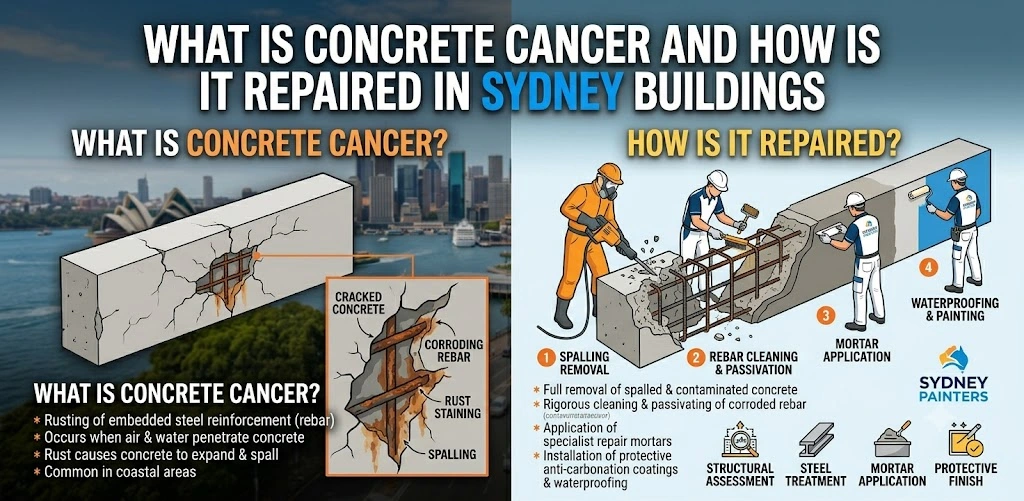
Concrete cancer is the progressive deterioration of reinforced concrete structures caused by steel reinforcement corrosion expanding within concrete matrices, generating internal pressure that fractures, spalls, and eventually dislodges surrounding concrete, compromising structural integrity in Sydney buildings exposed to coastal salt, moisture, and carbonation.
Sydney’s coastal geography makes concrete cancer repair one of the most common building remedial challenges across the city. Suburbs including Bondi, Manly, Cremorne, Neutral Bay, and Kirribilli experience accelerated concrete deterioration from salt-laden air penetrating concrete cover and triggering steel corrosion cycles.
Left unaddressed, concrete cancer progresses from surface staining to structural failure, transforming a straightforward repair into a major structural remediation project requiring significantly greater investment.
What Causes Concrete Cancer in Sydney Buildings
Concrete cancer in Sydney buildings develops through 3 primary deterioration pathways accelerated by the city’s coastal environment and ageing building stock.
- Chloride-induced corrosion
Chloride-induced corrosion dominates Sydney coastal buildings near the ocean. Salt particles carried in sea air penetrate porous concrete, reach steel reinforcement, and trigger corrosion reactions. Corroding steel expands significantly within the concrete matrix, generating internal pressure sufficient to fracture surrounding concrete regardless of original construction quality.
- Carbonation
Carbonation affects older Sydney buildings, where a thinner concrete cover was standard practice. Atmospheric carbon dioxide gradually reacts with concrete’s alkaline chemistry, breaking down the protective layer on steel reinforcement and allowing corrosion to begin. Buildings in inner Sydney suburbs, including Paddington, Surry Hills, and Glebe, with pre-1970 construction commonly show carbonation-related concrete cancer.
- Poor original construction
Poor original construction, including inadequate concrete cover over reinforcement, insufficient compaction creating internal voids, and low-quality concrete mixes, accelerates deterioration from both chloride and carbonation pathways simultaneously.
Visual Signs of Concrete Cancer on Your Property
Visual signs of concrete cancer appear in predictable sequences, allowing early identification before structural damage becomes serious and straightforward repairs are no longer possible.
- Early signs
Early signs include rust-brown staining on concrete surfaces above reinforcement positions, fine hairline cracks running parallel to underlying steel bars, and minor surface dampness suggesting moisture reaching reinforcement beneath.
- Developing signs
Developing signs include wider map or network cracking patterns across larger surface areas, visible concrete delamination where surface layers begin separating from the underlying structure, and expanding rust stains indicating active corrosion continuing beneath the surface.
- Advanced signs
Advanced signs include concrete spalling where chunks detach from surfaces, exposed steel reinforcement visible through fractured concrete, significant structural cracking, and falling concrete debris creating serious safety hazards for building occupants and pedestrians.
Identify early signs by examining balcony soffits, car park ceilings, facade columns, and beam undersides where water accumulates, and the concrete cover is typically thinnest. Tap concrete surfaces with a hammer. Hollow sounds indicate delamination requiring immediate professional assessment.
Structural Risk Assessment for Concrete Cancer Damage
Structural risk assessment for concrete cancer damage determines repair scope, urgency classification, and appropriate intervention methods before concrete repairs. Sydney contractors mobilise to the site.
Professional assessments use 4 primary investigation methods.
- Visual inspection documents crack patterns, staining locations, spalling extent, and exposed reinforcement mapping deterioration distribution across the building.
- Cover meter surveys measure concrete cover depth over reinforcement, identifying under-covered areas vulnerable to accelerated deterioration.
- Carbonation depth testing using indicator solutions determines how deeply carbonation has penetrated relative to reinforcement depth.
- Chloride sampling through concrete core extraction confirms salt contamination levels at reinforcement depth, verifying active corrosion risk.
Assessment findings determine repair urgency. Immediate intervention addresses exposed reinforcement or falling concrete, creating safety hazards. Short-term intervention within 3-6 months suits active corrosion with adequate cover remaining. Planned maintenance within 12 months addresses early-stage deterioration without immediate structural risk.
Professional Concrete Cancer Repair Process in Sydney
Professional concrete cancer repair in Sydney follows a systematic process, restoring structural integrity and preventing recurrence through comprehensive treatment rather than cosmetic surface patching.
Concrete removal eliminates all deteriorated material beyond the visible damage boundary, ensuring a sound substrate for repair materials.
Steel preparation involves thorough mechanical cleaning of exposed reinforcement, removing all corrosion products and preparing surfaces for treatment.
Corrosion inhibitor application treats cleaned steel, preventing future corrosion initiation in repaired areas through zinc-rich primers or migrating inhibitor systems.
Repair mortar application uses polymer-modified cementitious repair systems, achieving strong bonds with surrounding concrete and matching long-term durability requirements.
Surface finishing achieves texture match with the surrounding concrete, preventing visible repair patches on architectural facades and maintaining building appearance.
Protective coating application seals repaired and surrounding areas, preventing moisture and chloride reinvasion, triggering new deterioration cycles.
Understanding long-term paint maintenance plans for commercial buildings helps Sydney property managers schedule concrete cancer inspections within broader building maintenance programs.
Waterproof Coating Systems Preventing Concrete Cancer
Waterproof coating systems for concrete cancer prevention are protective membrane or penetrating sealer applications, creating moisture and chloride barriers protecting steel reinforcement from the corrosive exposure that initiates deterioration cycles.
Waterproof coating systems appropriate for Sydney building concrete protection fall into 3 primary categories.
- Elastomeric acrylic membranes
including Dulux Acratex and Wattyl Granosite, create flexible moisture barriers accommodating concrete movement without cracking. These systems suit facades, balconies, and exposed horizontal surfaces receiving direct weather exposure.
- Penetrating silane/siloxane sealers
work by absorbing into concrete, creating water-repelling barriers while maintaining the surface’s ability to breathe. These systems suit dense concrete surfaces where surface membranes would trap existing moisture beneath.
- Cementitious crystalline coatings
react chemically with concrete, creating permanent internal barriers blocking the tiny pores through which water travels. These suit below-ground applications and water-retaining structures.
Recoating intervals vary depending on exposure severity, product specification, and maintenance history. Coastal Sydney properties generally require more frequent recoating than sheltered inland elements. A qualified assessor determines appropriate intervals for your specific building.
Concrete Cancer Prevention for Sydney Coastal Buildings
Concrete cancer prevention for Sydney coastal buildings combines 4 proactive strategies: reducing chloride exposure, monitoring reinforcement protection, and maintaining coating system integrity across building lifecycles.
- Regular cleaning
Regular cleaning removes salt accumulation from concrete surfaces before penetration reaches reinforcement depth. High-pressure washing using clean water removes surface chloride deposits effectively. Buildings closer to the ocean benefit from more frequent cleaning schedules, keeping salt loads manageable.
- Cathodic protection systems
Cathodic protection systems installed in high-risk coastal buildings use electrical currents to reverse the corrosion process, protecting steel reinforcement without chemical treatment. These systems suit heritage buildings, critical infrastructure, and structures where ongoing chemical treatment proves impractical.
- Scheduled inspections
Scheduled inspections at regular intervals identify early deterioration signs before structural compromise develops. Inspections by qualified building remedial engineers document condition changes between cycles, enabling trend analysis and early intervention planning.
- Coating maintenance
Coating maintenance addressing minor damage, including cracks, blisters, and delamination, prevents moisture from finding pathways through protective systems. Small maintenance interventions prevent coating failure, leading to chloride penetration requiring far more extensive concrete repairs.
Proper surface preparation principles underpinning residential painting apply equally to protective coating applications on concrete structures. Substrate condition determines coating performance and longevity regardless of product quality.
Conclusion
Concrete cancer gets expensive fast. Act early.
Concrete cancer follows a predictable pattern that consistently rewards early action and punishes delay. The building owners who act on the first rust stain spend a fraction of what those who wait for visible spalling will eventually face. No version of this problem gets cheaper by waiting. Only versions that get dramatically more complex and disruptive need to be addressed.
The most expensive concrete cancer repair is always the one that waited too long.
Protect your Sydney building from progressive concrete deterioration before minor staining becomes a structural emergency. Contact Luxury Design Painting for professional concrete cancer assessment, comprehensive building remedial work in Sydney, and protective coating programs, delivering structural restoration and long-term prevention, keeping your property safe, compliant, and protected.
Praptie
Luxury Design Painting