
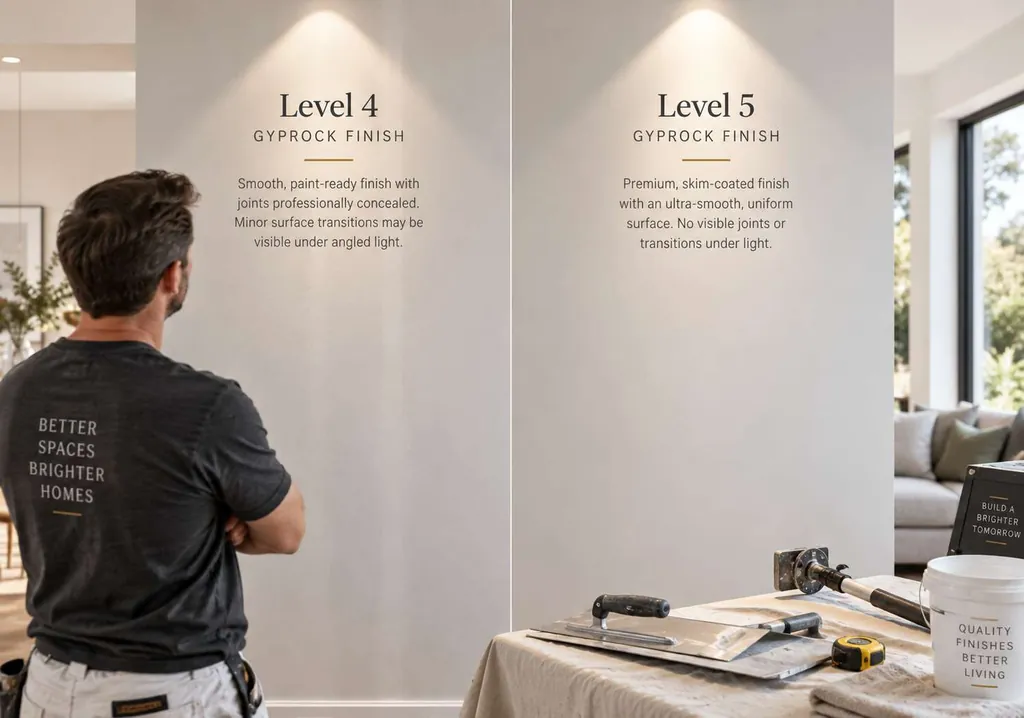
A Level 4 vs Level 5 Gyprock finish involves both the plasterboard finishing process and the required preparation of the underlying framing.
Level 4 uses the standard three-coat joint-finishing system, while Level 5 requires the same jointing process, tighter framing alignment requirements, and a skim coat across the entire plasterboard surface to reduce differences in surface texture and porosity.
For many standard rooms, a well-executed Level 4 finish is enough. Level 5 becomes worth considering when strong daylight, wall washers, dark colours, higher-sheen paint or premium architectural details make small surface variations easier to see.
The goal is not to specify Level 5 everywhere. It is to match the plasterboard finish to the lighting, paint and visual standard of the finished room.
What Is a Level 4 Gyprock Finish?
A Level 4 Gyprock finish prepares plasterboard for quality decorative painting without skim coating the complete board face.
The plasterboard joints are taped and set with joint compound. The compound is built and feathered across the joints, fastener heads are covered, internal and external corners are finished, and the surface is sanded and prepared.
The important point is what happens away from those areas.
Most of the plasterboard face remains the manufacturer's paper surface. This means the finished wall contains the board faces alongside areas treated with joint compound.
A properly completed Level 4 finish can look excellent under suitable lighting and paint conditions. Standard bedrooms, studies and many other residential spaces do not gain meaningful visual value simply because Level 5 has been specified.
The room needs to justify the additional finishing work.
What Is a Level 5 Gyprock Finish?
A Level 5 Gyprock finish uses the three-coat jointing process required for Level 4, together with more stringent framing preparation and a thin skim coat applied across the entire plasterboard surface.
The joints, corners, fasteners and accessories are properly finished before the full-surface treatment is applied. The skim coat helps reduce differences in texture and porosity between the plasterboard paper and jointed areas, creating a more uniform surface for decoration.
This matters because plasterboard paper and joint compound are different surfaces. Their texture, porosity, and response to paint are not identical.
Under demanding lighting, those differences can become visible as changes across the finished wall.
Level 5 reduces that visual differentiation. It is particularly valuable for large uninterrupted walls, architectural interiors, and spaces where the paint and lighting place greater demands on the substrate.
Luxury Design Painting's Gyprock and plastering service in Sydney includes Level 5 finishing for projects where a highly uniform wall surface is required before painting.
Level 4 vs Level 5 Gyprock Finish at a Glance
Both finishes can produce smooth, professionally painted walls. The difference becomes important when the room creates demanding viewing conditions.
| Feature | Level 4 | Level 5 |
|---|---|---|
| Joints | Fully set | Fully set |
| Fasteners and accessories | Finished | Finished |
| Full board skim coat | No | Yes |
| Surface uniformity | High | Higher |
| Standard residential rooms | Suitable | Optional |
| Raking or critical light | Surface variation can become visible | Recommended |
| Dark or deep colours | Requires careful assessment | Recommended |
| Premium architectural interiors | Depends on conditions | Strong option |
A Level 4 finish is not an unfinished or low-quality wall. Level 5 simply adds another stage where the completed design demands greater surface uniformity.
What Is Skim Coating?
Skim coating means applying a thin layer of finishing compound across the complete plasterboard surface.
It is not the same as building a traditional solid plaster wall. The skim coat forms part of the plasterboard finishing process and is designed to create a more consistent surface for subsequent decoration.
This helps reduce visible differences between the plasterboard face and areas containing joint compound.
The skim coat still requires skilled application, appropriate finishing and correct sanding. Poorly applied skim coating can introduce its own surface defects, so Level 5 should not be treated as a simple extra coat that automatically produces better walls.
Why Does Lighting Change the Gyprock Finish You Need?
Lighting changes how easily you see small variations across a wall.
Raking light is light that travels almost parallel to the wall instead of hitting it directly from the front. Small changes in surface height then create highlights and shadows.
Imagine afternoon sunlight entering through floor-to-ceiling windows and travelling sideways across a long living-room wall. A joint or sanding variation that disappears under soft ceiling lighting can become visible as the sun moves across the room.
The same issue occurs with skylights, sliding glass doors, spotlights, wall washers and architectural LED lighting.
Long corridors with strong light entering from one end create another demanding condition.
This is why the plasterboard specification should consider the completed room rather than the empty construction site.
A Level 5 Gyprock finish becomes more valuable when the final lighting places the wall under this type of visual scrutiny.
How Do Paint Colour and Sheen Affect the Finish?
Paint does not hide inadequate wall preparation. Certain colours and finishes make surface quality more important.
Dark and deep colours create demanding visual conditions when combined with strong directional light. Long uninterrupted dark walls deserve particular attention because small variations have fewer visual distractions around them.
Paint sheen matters as well.
Matt and flatter finishes reflect less light directly and provide more forgiving viewing conditions. As reflectivity increases, surface variations become easier to notice under certain lighting arrangements.
This does not mean every dark wall or paint with sheen automatically needs Level 5.
Look at the complete combination:
Wall size + lighting direction + paint colour + sheen + expected finish
A premium architectural living room with full-height glazing and a deep paint colour has different requirements from a softly lit spare bedroom painted in a light matt finish.
For the painting stage, Luxury Design Painting also provides interior house painting in Sydney, allowing surface preparation and the decorative coating system to be considered together.
When Is a Level 4 Gyprock Finish Enough?
Level 4 is enough when the room does not place extreme visual demands on the wall, and a properly completed standard decorative finish meets the project's expectations.
It suits many bedrooms, studies, utility areas and residential interiors with soft or moderate lighting. Light colours and forgiving matt or low-sheen finishes also reduce the visual sensitivity of the surface.
The workmanship still matters.
A poorly set and sanded Level 4 wall does not become acceptable because the room has soft lighting. Joints, fasteners, corners, and repairs still need correct finishing.
The key point is that paying for Level 5 across every wall does not automatically create meaningful visual value.
If a room has normal lighting, standard wall dimensions, and a forgiving decorative finish, a high-quality Level 4 finish can be the correct specification.
When Is Level 5 Worth the Extra Work?
Level 5 becomes worth considering when small surface differences would interfere with the intended appearance of the room.
Strong candidates include premium living areas with large windows, architect-designed interiors, long uninterrupted walls, rooms with skylights and spaces using wall washers or strong directional lighting.
It also deserves consideration for deep feature colours and other decorative schemes where the wall itself becomes a prominent design element.
Premium residential projects across Sydney can contain both specifications. A utility room can use Level 4 while a large open-plan living area receives Level 5 because afternoon light travels directly along its walls.
That is a better approach than specifying the most intensive finish everywhere.
The plasterboard finish should respond to each space.
Luxury Design Painting provides Level 5 Gyprock and plastering for Sydney renovations and interiors where the final lighting and painting specification require greater surface uniformity.
Does Level 5 Mean the Wall Will Be Perfect?
No. Level 5 improves surface uniformity, but it cannot correct major construction problems underneath the plasterboard.
Bowed framing remains bowed. Poorly installed sheets need appropriate correction. Active cracks, structural movement, damaged plasterboard and badly formed corners cannot simply be hidden under a skim coat. Holes, dents and other wall damage also need proper repair before the finishing and painting stages begin. If your walls have existing damage, see our guide on whether painters fix holes in walls before painting to understand what should be repaired before painting starts.
Level 5 refines a correctly built and prepared wall. It does not rebuild a defective one.
Existing walls also need inspection before being upgraded.
If a wall is cracking because movement remains active, that cause needs attention before additional finishing work begins.
Level 5 refines a correctly built and prepared wall. It does not rebuild a defective one.
That distinction matters when homeowners are deciding whether a cosmetic upgrade or an actual Gyprock repair is required.
Does Level 5 Require More Work Than Level 4?
Yes. Level 5 requires more material, labour and finishing because the skim coat extends across the entire plasterboard surface.
The difference does not stop at applying compound.
The surface needs controlled application, finishing, sanding and inspection to achieve the intended uniformity.
Larger walls and demanding architectural conditions increase the importance of consistent workmanship.
The more useful question is therefore not simply whether Level 5 requires more work.
Ask whether the room will expose the differences that Level 5 is designed to reduce.
For a standard room under forgiving conditions, the extra preparation provides limited practical benefit. For a six-metre living-room wall receiving strong afternoon raking light, that preparation can directly affect the appearance of the completed interior.
The specification should follow the finished conditions.
Should Level 5 Be Completed Before Premium Interior Painting?
Yes. The plasterboard finish should be decided and completed before the final painting system begins.
A properly coordinated sequence looks like this:
Gyprock installation > Joint setting > Level 4 or Level 5 finishing > Sanding and inspection > Primer or sealer > Finish coats
Trying to solve inadequate plasterboard finishing through additional paint is the wrong approach. Paint quality cannot correct joint lines, sanding defects or surface irregularities underneath it.
This is where coordinating the trades becomes valuable. The plastering team needs to understand the paint colour, sheen and final lighting conditions before deciding what preparation is appropriate.
Luxury Design Painting's Gyprock plastering in Sydney can connect plasterboard installation, setting and Level 5 skim finishing with the painting stage, keeping the expected wall finish clear throughout the project.
Level 4 vs Level 5: Which Should You Choose?
Choose Level 4 when the room has standard lighting, a forgiving paint finish, and no strong visual requirement for full-surface uniformity.
Consider Level 5 when strong directional daylight crosses the wall, large windows or skylights create critical lighting, deep colours are planned, reflective finishes increase surface visibility, or the wall forms an important architectural feature.
Also consider how long and exposed the wall is.
A small bedroom wall and a long open-plan living-room wall do not create the same viewing conditions.
The central decision is simple:
Level 5 is not automatically the better-value specification. It is the right specification when the completed room demands greater surface uniformity.
A professional assessment should therefore consider the wall construction, lighting, paint selection and expected visual result together.
Frequently Asked Questions
What is the main difference between Level 4 and Level 5 Gyprock?
Level 5 includes the Level 4 joint-finishing stages plus a skim coat across the entire plasterboard surface.
Does every home need a Level 5 finish?
No. Level 4 suits many normal residential rooms. Level 5 becomes valuable where lighting, paint or architectural expectations demand greater surface uniformity.
Do dark walls need Level 5?
Not automatically. Deep colours combined with directional lighting, long walls or more reflective finishes make Level 5 worth considering.
Is a Level 5 finish the same as plaster?
No. A Level 5 plasterboard finish uses finishing compound skimmed across plasterboard. Traditional solid plaster is a different wall system.
Can an existing Level 4 wall be upgraded to Level 5?
Skim coating an existing Level 4 wall can improve surface uniformity, but it does not automatically make the wall a Level 5 finish under AS/NZS 2589. Level 5 also involves specific framing, substrate, and finishing requirements that need to be addressed as part of the specification. Existing walls should therefore be assessed before the required finish is described as Level 5.
Does Level 5 make walls perfectly flat?
No. Level 5 improves surface uniformity. It does not correct bowed framing, badly installed plasterboard, active structural movement, or other major underlying defects.
Not Sure Whether Your Project Needs Level 4 or Level 5?
The right finish depends on what the completed room will actually look like.
Natural light, architectural lighting, wall length, paint colour, sheen and the expected visual standard should all be considered before the plastering specification is locked in.
Luxury Design Painting brings more than 30 years of experience to premium Sydney homes and handles Gyprock installation, joint setting, detailed plastering, Level 5 skim finishing and professional painting. Keeping these stages connected helps ensure the wall preparation matches the final decorative finish from the beginning.
Request a Gyprock & Plastering Assessment from Luxury Design Painting to determine whether Level 4 or Level 5 is the right finish for your project.
admin
Luxury Design Painting