
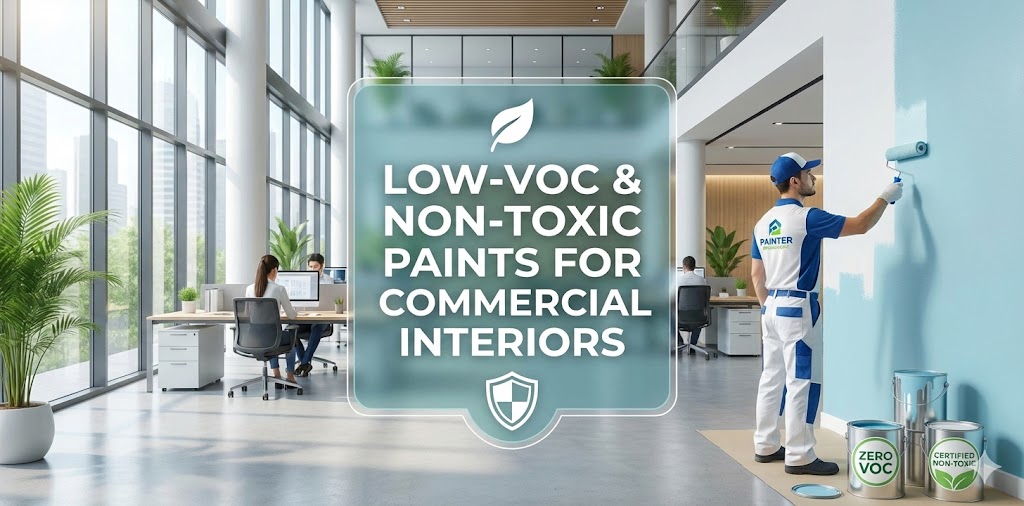
Want to increase your employees’ productivity from 5% up to over 60%? Then, use Low-VOC and Non-Toxic Paints across your company premises, especially in the production unit where your employees actually work.
Why?
Low-VOC and non-toxic paints for commercial interiors protect employee health, meet workplace safety standards, and maintain business operations without toxic fume disruptions. Modern formulations deliver professional durability while eliminating harmful chemical emissions that compromise air quality and staff wellbeing in occupied spaces.
In this guide, you’re going to know that:
- VOCs cause headaches, fatigue, and respiratory issues
- Non-toxic paints meet stricter health standards
- Air quality affects productivity measurably
- Green Building certifications require low-VOC
- Quick-dry options minimise business disruption
What Makes Paint “Low-VOC” vs “Non-Toxic” in Commercial Applications
Low-VOC paints contain fewer than 50 grams per litre of volatile organic compounds.
Non-toxic paints eliminate all hazardous chemicals, including VOCs, heavy metals, and carcinogens, completely.
The distinction matters legally and health-wise.
Low-VOC reduces emissions. Non-toxic eliminates dangerous substances entirely. Both surpass standard commercial paints, releasing 150-250g/L of harmful compounds.
Your choice depends on space usage, occupancy levels, and health priorities.
Childcare centres need non-toxic. Standard offices work fine with low-VOC. Medical facilities require both certifications, typically.
Why Traditional Commercial Paints Create Serious Workplace Health Hazards
Standard commercial paints off-gas for weeks after application.
Off-gassing is the process by which volatile chemicals evaporate from painted surfaces into indoor air.
Staff breathe these emissions constantly. Headaches start within hours. Fatigue builds over days. Respiratory irritation persists for weeks.
Productivity drops 5-15% in freshly painted spaces using high-VOC products. Sick leave claims increase measurably. WHS complaints rise dramatically.
Traditional formulations contain solvents that linger. Modern alternatives cure cleaner and faster.
The health risks aren’t worth the minimal cost savings.
Health Benefits of Low-VOC Formulations in Occupied Commercial Spaces
Indoor Air Quality (IAQ) measures the cleanliness and safety of air inside buildings.
Low-VOC paints improve IAQ immediately and dramatically.
Staff report fewer headaches within days of switching. Respiratory complaints drop by 60-80%. Energy levels stay consistent throughout workdays.
Better air quality means better performance measurably.
Studies show 11% productivity gains in buildings with superior Indoor Air Quality (IAQ). Sick leave has reduced by 35%. Staff retention improves noticeably.
Your paint choice affects more than walls. It affects your bottom line directly.
Regulatory Standards and Green Building Certifications Requiring Low-VOC Products
| Standard/Certification | VOC Limit Requirements |
| Green Star (Australia) | Maximum 50g/L for flat, 75g/L gloss |
| NABERS Indoor Environment | Low-VOC mandatory for 4-star+ |
| WELL Building Standard | Zero-VOC preferred, max 50g/L |
| Safe Work Australia | WHS compliance requires SDS documentation |
| GECA Certification | Strict limits plus toxic substance bans |
Green Building certifications aren’t optional for modern commercial developments.
Tenants demand them. Property values depend on them. Insurance premiums reflect them.
NABERS ratings assess energy efficiency and indoor environment quality for commercial buildings.
Green Star certification evaluates sustainability across design, construction, and operation phases comprehensively.
Buildings without these certifications lease more slowly and command lower rents. Low-VOC paint specifications appear in every green building requirement.
Your paint choice affects building certification directly.
Non-Toxic Paint Formulations: Beyond Just Low-VOC Standards
Non-toxic goes further than reducing VOCs alone.
Non-toxic paints eliminate heavy metals, formaldehyde, pesticides, and known carcinogens entirely.
They use natural pigments, mineral-based binders, and plant-derived additives. Zero synthetic chemicals. Zero toxic off-gassing.
These formulations suit sensitive environments specifically:
- Childcare centres where children touch everything
- Healthcare facilities with immunocompromised patients
- Aged care homes with respiratory-vulnerable residents
- Food preparation areas requiring zero contamination risk
- Wellness centres promoting holistic health environments
Non-toxic costs 20-40% more than low-VOC options. The premium protects vulnerable populations completely.
Performance Characteristics: Do Low-VOC Paints Sacrifice Durability or Coverage?
Old low-VOC formulations performed poorly compared to traditional paints.
Modern technology changed everything completely.
Today’s low-VOC commercial paints match or exceed traditional formulations across all metrics.
Coverage rate measures how many square metres one litre of paint covers effectively.
Premium low-VOC products cover 12-16m² per litre. Traditional paints cover 10-14m². Better coverage means lower costs per project.
Washability rating indicates how many cleaning cycles the paint withstands before degrading.
Low-VOC commercial formulations handle 5,000+ scrub cycles. Traditional paints fail around 3,000 cycles. Superior durability extends repainting intervals significantly.
The performance excuse for avoiding low-VOC products vanished years ago.
Fast-Drying Low-VOC Options for Minimising Commercial Downtime
Dry time is the period of time paint needs before recoating or returning to normal use.
Historically, traditional low-VOC paints dried slowly. Modern formulations dry faster than solvent-based alternatives.
Advanced acrylic and waterborne urethane technologies enable:
- Touch-dry in 30-60 minutes after application
- Recoat-ready in 2-4 hours between coats
- Full cure in 24-48 hours for normal use
Friday evening to Monday morning provides 60+ hours. Complete office repaints happen over weekends using fast-dry low-VOC products.
Retail spaces paint overnight between closing and opening. Restaurants repaint between lunch and dinner services.
Zero revenue loss. Zero customer disruption. Zero toxic fume complaints.
Application Techniques That Maximise Low-VOC Paint Performance
Low-VOC paints behave differently from traditional formulations.
Proper application techniques matter more than ever.
Surface preparation involves cleaning, repairing, and priming substrates before painting.
Low-VOC products bond better to properly prepared surfaces. They show imperfections more readily than high-VOC alternatives.
Professional application requirements include:
- Thorough surface cleaning, removing all contaminants
- Proper priming with compatible low-VOC primers
- Adequate ventilation during application and curing
- Appropriate roller covers for smooth application
- Correct film thickness for optimal performance
DIY attempts with low-VOC products fail more often than traditional paints. The margin for error shrinks considerably.
Professional painters understand these nuances instinctively.
Cost Analysis: Initial Investment vs Long-Term Health and Productivity Benefits
Low-VOC paints cost 15-30% more than standard commercial products upfront.
That premium returns multiples through reduced health costs and improved productivity.
Calculate the real cost difference properly:
- Initial paint premium: $2,000 extra for a typical office
- Avoided sick leave: $5,000+ annually from reduced health issues
- Productivity gains: $15,000+ from 5% performance improvement
- Faster occupancy: $3,000 saved from immediate space usage
The math favours low-VOC overwhelmingly within the first year alone.
Add certification benefits, tenant attraction, and brand reputation. Low-VOC becomes the only logical choice for commercial interiors.
Odour Management: Keeping Business Operations Running During Painting Projects
Paint odour comes from VOCs evaporating during application and curing periods.
Low-VOC products smell minimally during application. They become odour-free within hours rather than days.
This difference changes project scheduling completely.
Paint on Friday afternoon. Staff work normally on Monday morning. Customers never notice that the refresh happened.
Traditional high-VOC paints smell for 5-7 days minimum. They disrupt operations significantly. Drive away customers noticeably.
Odour complaints trigger negative reviews instantly. Low-VOC formulations prevent this problem entirely.
Substrate Compatibility: Which Surfaces Work Best With Low-VOC Formulations
Low-VOC paints work on most commercial substrates when applied correctly.
| Surface Type | Best Low-VOC Product |
| Plasterboard/Drywall | Water-based acrylic latex paints |
| Previously Painted Walls | Low-VOC acrylic with proper primer |
| Concrete/Masonry | Breathable mineral-based coatings |
| Metal Surfaces | Water-based epoxy or urethane systems |
| Timber/Woodwork | Low-VOC acrylic or plant-oil stains |
| High-Moisture Areas | Mould-resistant low-VOC bathroom paints |
Substrate is the underlying surface material receiving a paint or coating application.
Each substrate needs compatible primers and topcoats. Incompatible combinations fail regardless of VOC levels.
Professional painters test compatibility before committing to full applications.
Why Professional Application Matters More With Low-VOC Products
Low-VOC formulations demand higher application skills than traditional paints.
They dry faster. Show flaws more readily. Require precise technique.
Amateur applications create visible defects:
- Lap marks from inconsistent rolling technique
- Flash rust on metal from inadequate priming
- Patchy coverage from incorrect film thickness
- Adhesion failures from contaminated surfaces
Professional commercial painters understand low-VOC chemistry completely. They adjust techniques for optimal results consistently.
The money saved using cheap painters gets spent fixing their mistakes. Often costing double the original professional quote.
Luxury Design Painting specialises in low-VOC and non-toxic commercial applications where health, performance, and minimal disruption matter critically. Get expert guidance on creating healthier workplaces that support productivity and wellbeing.
