
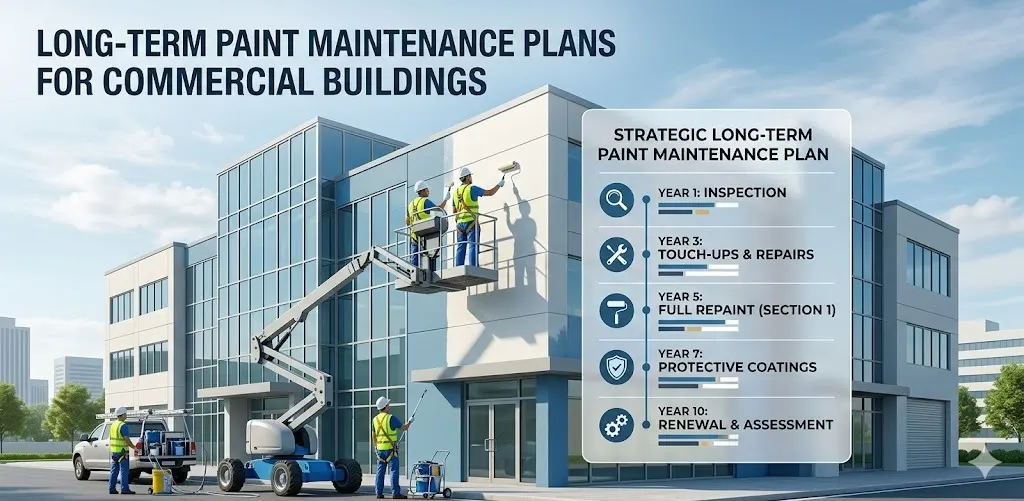
Long-term paint maintenance plans for commercial buildings are structured programs combining scheduled inspections, preventative repairs, cleaning protocols, and documentation systems that preserve coating integrity across 10-15 year lifecycles while reducing total ownership costs by 60%.
Commercial buildings without paint maintenance plans repaint far more often, and pay full-repaint costs each cycle. Buildings with structured programs extend intervals to 10-15 years through strategic intervention. Property managers implement maintenance plans to transform reactive emergencies into predictable capital expenditure.
Essential Components of Commercial Building Paint Maintenance Programs
Commercial building paint maintenance programs consist of 5 components, including inspection schedules, repair protocols, cleaning procedures, environmental monitoring systems, and budget allocation frameworks, preserving coating performance across extended timeframes.
The paint maintenance program is a documented system scheduling inspections, repairs, and protective treatments, preventing premature coating failure.
Maintenance program components include annual condition assessments identifying chalking, cracking, peeling, or colour fading requiring intervention. Touch-up repair protocols address localised failures before spreading. Cleaning schedules remove contaminants, causing accelerated degradation. Environmental monitoring tracks moisture, temperature, and UV exposure affecting coating longevity. Budget forecasting allocates capital for planned interventions, preventing emergency expenditure.
Want to verify paint maintenance requirements?
Prepare baseline condition documentation establishing performance benchmarks. Compliance with maintenance schedules preserves warranty coverage and building valuations. Buildings lacking documented programs experience 40% higher total painting costs over 20-year ownership periods.
Select commercial painting contractors offering maintenance support programs if long-term cost control matters.
| Maintenance Component | Implementation Frequency |
| Visual condition inspections | Annually or biannually |
| Touch-up repair interventions | As identified, typically yearly |
| Pressure washing cleaning | Every 2-3 years for exteriors |
| Environmental monitoring | Continuous via sensors |
| Budget allocation reviews | Annually, during planning cycles |
Annual Inspection Protocols Identifying Paint Degradation Before Failure
Annual inspection protocols for commercial building paint maintenance identify surface chalking, film cracking, adhesion loss, colour fading, and biological growth, signaling intervention requirements before complete coating failure necessitates full replacement.
Inspection protocol is a systematic assessment procedure evaluating coating condition against performance criteria, determining repair urgency.
Annual inspections document degradation patterns through photographic records, condition ratings, and defect mapping, establishing intervention priorities. Inspectors assess chalking levels using ASTM D4214 standards, rating surface powder from 0 (none) to 10 (severe). Crack density measurements per square meter indicate substrate movement or coating brittleness. Adhesion testing via cross-cut or pull-off methods quantifies bond strength remaining. Colour measurements using spectrophotometry document fading rates, establishing repaint timing.
Commercial buildings’ property managers schedule annual inspections during dry seasons, enabling accurate moisture assessment. Inspection timing affects intervention planning. Spring inspections allow summer repair completion. Autumn assessments enable winter planning cycles.
Professional commercial painters like Luxury Design Painting conduct inspections using calibrated equipment and standardised reporting formats, ensuring consistency across annual cycles.
Inspection findings prioritise repairs into immediate, short-term, and long-term categories. Immediate repairs address active water penetration or structural exposure. Short-term interventions correct localised adhesion failures. Long-term planning schedules full repainting based on degradation trajectories.
Preventative Touch-Up Programs Extending Commercial Paint Lifecycles
Preventative touch-up program is an essential element in a long-term paint maintenance plan for commercial buildings. Preventative touch-up program includes repairing localised coating failures, addressing minor damage, and protecting vulnerable areas, preventing small problems from escalating into full-scale repainting requirements costing 10-15 times more.
Touch-up programs for long-term paint maintenance plans for commercial buildings target high-wear zones, including door frames, handrails, corridor intersections, and mechanical room entries experiencing accelerated wear. Contractors clean damaged areas, apply matching primers, and recoat using original paint specifications, maintaining colour consistency. Touch-ups address 5-10% of the total building surface area annually, preventing failures from spreading to adjacent zones.
Colour matching accuracy determines touch-up visibility. Original paint specifications, including manufacturer, product line, colour code, and finish type, enable precise matching. Buildings lacking documentation face matching difficulties in creating visible patches. Property managers maintain paint inventory for immediate touch-up availability.
Application timing affects touch-up performance. Contractors apply repairs during dry conditions with temperatures between 15-25°C, ensuring proper curing. Rushed applications during unfavorable conditions create premature touch-up failures requiring repetition.
Touch-up program benefits include 60-70% cost savings versus full repainting, minimal operational disruption, and extended coating lifecycles from 7 years to 12 years documented across commercial portfolios.
Understanding the best paint systems for high-traffic commercial spaces improves touch-up material selection, ensuring repairs match surrounding durability requirements.
Strategic Cleaning Schedules: Removing Contaminants and Degrading Commercial Coatings
Strategic cleaning schedules for a long-term paint maintenance plan for commercial buildings remove atmospheric pollutants, biological growth, industrial deposits, and urban grime, preventing chemical reactions and physical abrasion that accelerate coating degradation by 40-60%.
A cleaning schedule is a planned maintenance activity removing surface contaminants before they chemically or mechanically damage coating films.
Cleaning frequency for a long-term paint maintenance plan for commercial buildings depends on environmental exposure and building location. Urban commercial buildings require cleaning every 18-24 months due to higher pollutant concentrations. Suburban properties extend intervals to 30-36 months. Coastal buildings need annual cleaning to prevent salt accumulation, causing substrate corrosion.
Cleaning methods appropriate for commercial coatings include low-pressure washing at 500-1000 PSI using pH-neutral detergents. High-pressure systems exceeding 2000 PSI damage coating surfaces, creating substrate exposure. Chemical cleaners require compatibility testing to prevent paint softening or discoloration.
Contractors clean from top to bottom, preventing dirty runoff from staining cleaned areas. Adequate rinsing removes cleaning residues, preventing chemical reactions with coating films. Drying time before recoating ranges from 24 to 48 hours, depending on ambient conditions.
Cleaning program documentation tracks contaminant types, removal methods, and coating responses, informing future maintenance decisions. Buildings with documented cleaning records demonstrate superior coating longevity compared to facilities cleaned reactively.
Our professional painting contractors are familiar with commercial painting downtime minimisation, scheduling cleaning during off-hours, and preventing operational disruption.
Environmental Monitoring Systems Predicting Commercial Paint Performance Degradation
Environmental monitoring systems for long-term paint maintenance plans for commercial buildings track moisture levels, temperature fluctuations, UV exposure intensity, and pollutant concentrations, enabling predictive maintenance scheduling based on actual degradation acceleration rather than arbitrary time intervals.
Moisture sensors installed at vulnerable locations, including parapets, window sills, and basement transitions, detect water intrusion, causing coating adhesion loss. Temperature logging identifies thermal cycling frequency, accelerating coating fatigue. UV dosimeters measure cumulative solar exposure correlating with chalking and fading rates. Air quality monitors track sulfur dioxide and nitrogen oxide concentrations, causing chemical coating degradation.
Monitoring data feeds into predictive models calculating remaining coating life. Properties experiencing high UV exposure require repainting at 7-8 years. Buildings in sheltered locations extend lifecycles to 12-15 years using identical coating systems.
Data-driven maintenance planning optimises intervention timing. Properties repaint based on condition thresholds rather than fixed schedules. This approach reduces unnecessary repainting by 25-30% while preventing premature failures through early intervention.
Commercial building managers integrate monitoring systems with building management platforms for a long-term paint maintenance plan for commercial buildings, enabling automated alerts when degradation parameters exceed acceptable ranges.
Documentation and Record-Keeping Requirements for Commercial Paint Maintenance Programs
Documentation and record-keeping are systematic records. Documentation and record-keeping requirements for commercial building paint maintenance include original paint specifications, application records, inspection reports, repair histories, and warranty certificates, maintaining compliance, supporting insurance claims, and informing future maintenance decisions.
Property managers maintain comprehensive records establishing baseline conditions for comparison during inspections. Documentation includes paint manufacturer data sheets, colour formulations, surface preparation methods, application conditions, and coating thickness measurements. Digital photograph archives document pre-existing conditions and degradation progression.
Record-keeping periods vary by jurisdiction and building type. Commercial properties maintain 10-year minimum documentation supporting warranty claims and legal compliance. Heritage buildings require permanent records documenting all coating interventions.
Documentation formats include digital databases, cloud storage systems, and physical archives, ensuring accessibility during ownership transfers. Standardised reporting templates enable comparison across inspection cycles, identifying degradation trends.
Buildings with complete documentation achieve 15-20% higher valuations during sales compared to properties lacking maintenance records. Prospective buyers verify deferred maintenance through documentation review.
Budget Allocation Strategies for Long-Term Commercial Painting Maintenance
Budget allocation strategies for a long-term paint maintenance plan for commercial buildings distribute capital reserves, annual operating budgets, and contingency funds across inspection, cleaning, touch-up, and full repainting cycles, preventing deferred maintenance accumulation.
Property managers allocate 2-4% of building replacement value annually for a long-term paint maintenance plan for commercial buildings. Larger buildings plan their repainting budget across 10-year cycles. An annual allocation funds inspections, cleaning, and touch-ups. Full repainting reserves accumulate steadily over lifecycle intervals.
Budget forecasting incorporates degradation rates, environmental exposure, and coating performance data. Buildings in harsh environments increase allocations by 30-40%, preventing premature failures. Deferred maintenance creates exponential cost growth. Delayed touch-ups escalate into emergency repaints within a few years.
Capital planning committees approve multi-year maintenance schedules, stabilising expenditure patterns. Predictable budgets enable contractor relationship development and volume pricing negotiations.
Conclusion
Long-term paint maintenance plans for commercial buildings reduce total ownership costs by 60% through scheduled inspections, preventative touch-ups, strategic cleaning, environmental monitoring, and comprehensive documentation.
A structured annual program prevents far larger emergency repainting expenditure while maintaining property values and tenant satisfaction. Structured maintenance transforms reactive emergencies into predictable capital allocation cycles.
Implement professional commercial paint maintenance programs, protecting your property investment while controlling long-term costs. Contact Luxury Design Painting for customised maintenance scheduling, inspection services, and touch-up programs engineered for Australian commercial environments, delivering predictable performance and optimised capital expenditure across extended building lifecycles.
Praptie
Luxury Design Painting